New 3D Printing Technique Could Create 3D-Printed Arteries
Siobhan Treacy | October 22, 2018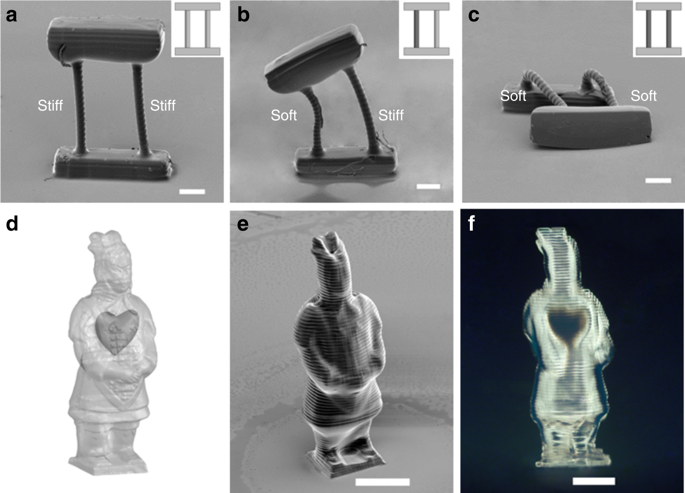 These are the objects that were printed using the new 3D-printing method. Source: University of Colorado
University of Colorado Boulder engineers created a 3D printing technique that controls the firmness of the printed object, allowing doctors to create artificial arteries and organ tissues.
With the new method, users have high-resolution programmable control over the firmness of the printed material. The control allows materials to mimic the geometry of blood vessels. If blood vessels can be 3D printed, it could lead to more personalized treatments for patients with hypertension and other blood vessel-related diseases.
"The idea was to add independent mechanical properties to 3D structures that can mimic the body's natural tissue," said Xiaobo Yin, an associate professor in the department of mechanical engineering and the senior author of the study. "This technology allows us to create microstructures that can be customized for disease models."
When developing the new method, the researchers looked at oxygen’s role in the printing and rigidity of a material.
"Oxygen is usually a bad thing in that it causes incomplete curing," said Yonghui Ding, a postdoctoral researcher in mechanical engineering and the lead author of the study. "Here, we utilize a layer that allows a fixed rate of oxygen permeation."
The new printing technique specifies solidified areas of an object by controlling the oxygen migration and light exposure, which indicate areas that are hard or soft.
"This is a profound development and an encouraging first step toward our goal of creating structures that function like a healthy cell should function," Ding said.
To demonstrate the technique, the team printed three sample versions of a beam that is supported by two rods. All the versions had the same size, shape and materials. The three variations were soft/soft, soft/hard, hard/hard; the stiffness of the supports rods dictated if the sample collapses fully or partially. The team also printed a Chinese warrior figure, with the warrior’s outermost layers printed as a hard material, while the inside was printed to be soft.
"The challenge is to create an even finer scale for the chemical reactions," said Yin. "But we see tremendous opportunity ahead for this technology and the potential for artificial tissue fabrication."
The paper on the new technique was published in Nature Communications.