
Watch How Ricequakes Simulate Ice Shelf and Rockfill Dam Collapse
S. Himmelstein | October 15, 2018University of Sydney researchers turned to breakfast to improve the ability to simulate and understand real-world collapse events, such as those occurring to ice shelves and rockfill dams.
These events occur as porous material at the bottom of a structure becomes saturated, making it weaker. Subsequently, material just above the weakened material collapses down into the saturated material. Vast volumes of materials are involved in these failures, which often happens over long time intervals, complicating the potential for researchers to analyze underlying mechanisms.
Puffed rice and milk served as stand-in materials for evaluating collapses. Pressure was applied at the top of a bottom-sealed hollow tube filled with puffed rice. Milk added to the tube seeped to the bottom and was absorbed upward into the puffed rice. The pressure pushing down on the rice eventually caused the dry puffed rice to collapse down into the softened wet puffed rice. The resulting localized crushing collapse, or “ricequake,” in the unsaturated region produced incremental global compaction and audible beats. The quakes occurred repeatedly as milk continued to saturate each new bottom layer as the time between collapse events grew longer.
The observations were incorporated into a model of capillary-driven crushing sequences that could prove useful for describing the behavior of much larger collapse events. The research is published in Science Advances.
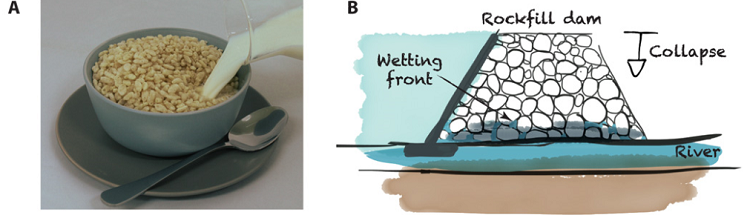 (A) Breakfast cereal. (B) Sketch of rockfill dam collapse under capillary action. Source: University of Sydney


I think there is a relative scale issue to be addressed here.
While the mechanism is interesting, it's effect is very minor when compared to that of hydraulic piping under the base of the retention structure. In short, wet rock is still a lot stronger than wet puffed rice.
Once water is able to seep under the base of the structure from the upstream face all the way to the downstream face, an initiating hollow will be started in the downstream face and work it's way all the way back to the upstream face, leading shortly to total structural collapse. It will do so much more quickly than the weight of the structure will crush the structure-base-water