Even the Best Robots Fall Down, But Now They Can Pick Themselves Up
Siobhan Treacy | August 28, 2018Researchers from the U.S. Army Research team and Johns Hopkins University have developed a system that allows robots in combat to pick themselves up when they fall, making them less reliant on soldiers.
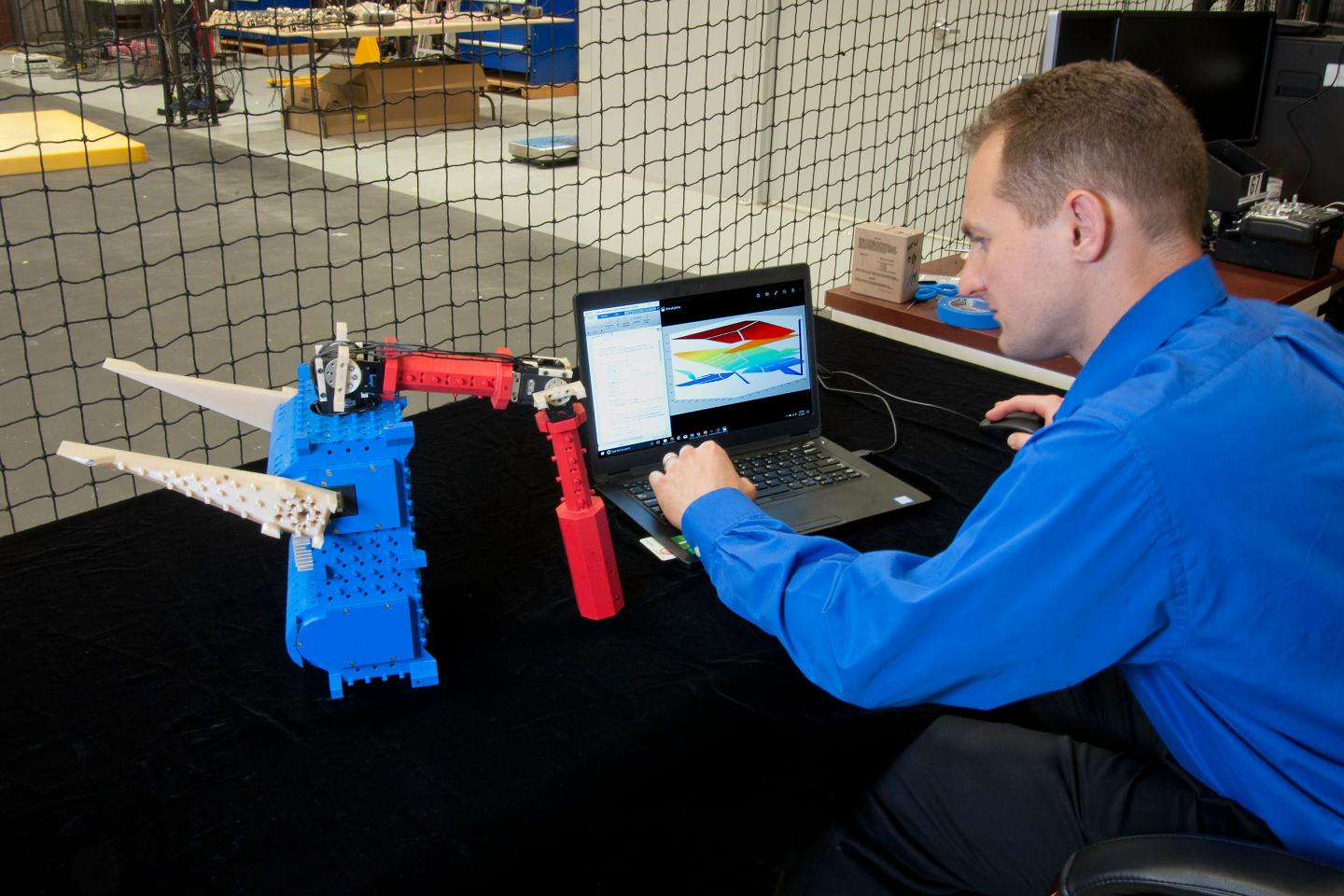 Dr. Chad Kessens, a roboticist with the U.S. Army Research Laboratory at Aberdeen Proving Ground, Md., comes up with innovative ideas for future military robots. Source: U.S. Army Research team
The newly developed system was named Advanced Explosive Ordnance Disposal Robotic System (AEODRS). This system is a new part of the EOD robotic systems family. It has a modular open system architecture and helps the robot pick itself up when it falls down.
"These robots exist to keep soldiers out of harm's way," said Reed Young, Robotics and Autonomy Program Manager at JHU/APL. "Self-righting is a critical capability that will only further that purpose."
To accomplish this self-righting, the researchers added extra joints to the robot.
"The analysis I've been working on looks at all possible geometries and orientations that the robot could find itself in," ARL researcher Dr. Chad Kessens said. "The problem is that each additional joint adds a dimension to the search space - so it is important to look in the right places for stable states and transitions. Otherwise, the search could take too long."
"Our analysis was made possible by our newly developed range adversarial planning tool, or RAPT, a software framework for testing autonomous and robotic systems,” JHU/APL researcher Galen Mullins said. "We originally developed the software for underwater vehicles, but when Chad explained his approach to the self-righting problem, I immediately saw how these technologies could work together."
"For this work, we were looking for states where the robot could transition from a stable configuration to an unstable one, thus causing the robot to tip over," Mullins further explained. "My techniques were able to effectively predict where those transitions might be so that we could search the space efficiently."
The AEODRS system has eight degrees of freedom. After the team tested each degree, they found that the robot could pick itself up off of flat ground, no matter how the robot fell.
"The Army and Navy want robots that can self-right, but we are still working to understand and evaluate what that means," Kessens said. "Self-right under what conditions? We have developed a metric analysis for evaluating a robot's ability to self-right on sloped planar ground, and we could even use it as a tool for improving robot design. Our next step is to determine what a robot is capable of on uneven terrain."
The paper on the new robot technology was published in Robotics and Automation Letters.