A Solid Solution to Preventing Li-Ion Battery Fires
S. Himmelstein | August 22, 2018 Adding powdered silica (in blue container) to the polymer layer (white sheet) that separates electrodes inside a test battery (gold bag) will prevent lithium-ion battery fires. Source: Gabriel Veith/ORNL
Lithium-ion batteries have been making headlines for all the wrong reasons. Valued for their high energy density, these batteries have a tendency to cause machinery and portable electronics to go up in smoke. The most notorious incidents involve battery fires on airplanes and in airports.
A small fault or damage to the thin separators that keep battery elements apart can lead to an internal short-circuit, heat build-up in the liquid electrolyte and the thermal runaway phenomenon that results in fires and explosions. A safer, flame-proof battery designed by researchers from U.S Oak Ridge National Laboratory (ORNL) and 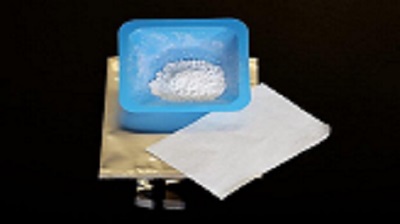 Adding powdered silica (in blue container) to the polymer layer (white sheet) that separates electrodes inside a test battery (gold bag) will prevent lithium-ion battery fires. Source: Gabriel Veith/ORNLthe University of Rochester offers a solid alternative to current Li-ion battery designs.
While watching his children toying with oobleck – a cornstarch-water mixture – one researcher observed that the goop solidified as it was poked. The substance liquefies as pressure is removed, a mechanism which inspired the application of reversible shear thickening behavior to the development of safer batteries.
Silica was suspended in conventional liquid electrolytes to mimic the use of cornstarch as a colloid. The 200 nm-diameter silica particles clump together and block fluid flow on impact, which could prevent electrodes from touching, and starting a fire, if a battery is damaged.
Incorporating the silica additive would incur minor adjustments to the conventional battery manufacturing process. At the end of the production line, conventional electrolytes are squirted into a battery case. The new formulation would solidify, as intended, if manipulated in this manner. The solution is to put the silica in place prior to electrolyte addition.
The research was presented at the 256th National Meeting & Exposition of the American Chemical Society in Boston.