Placenta-On-A-Chip Developed for Close Study of Placenta Behavior
Siobhan Treacy | August 14, 2018An artificial placenta model has been developed as an organ-on-a-chip by researchers at Vienna University of Technology (TU Wien). The artificial placenta has proven to be incredibly similar to a natural placenta, and researchers hope that it will be key to further research on the interaction between mother, baby and placenta.
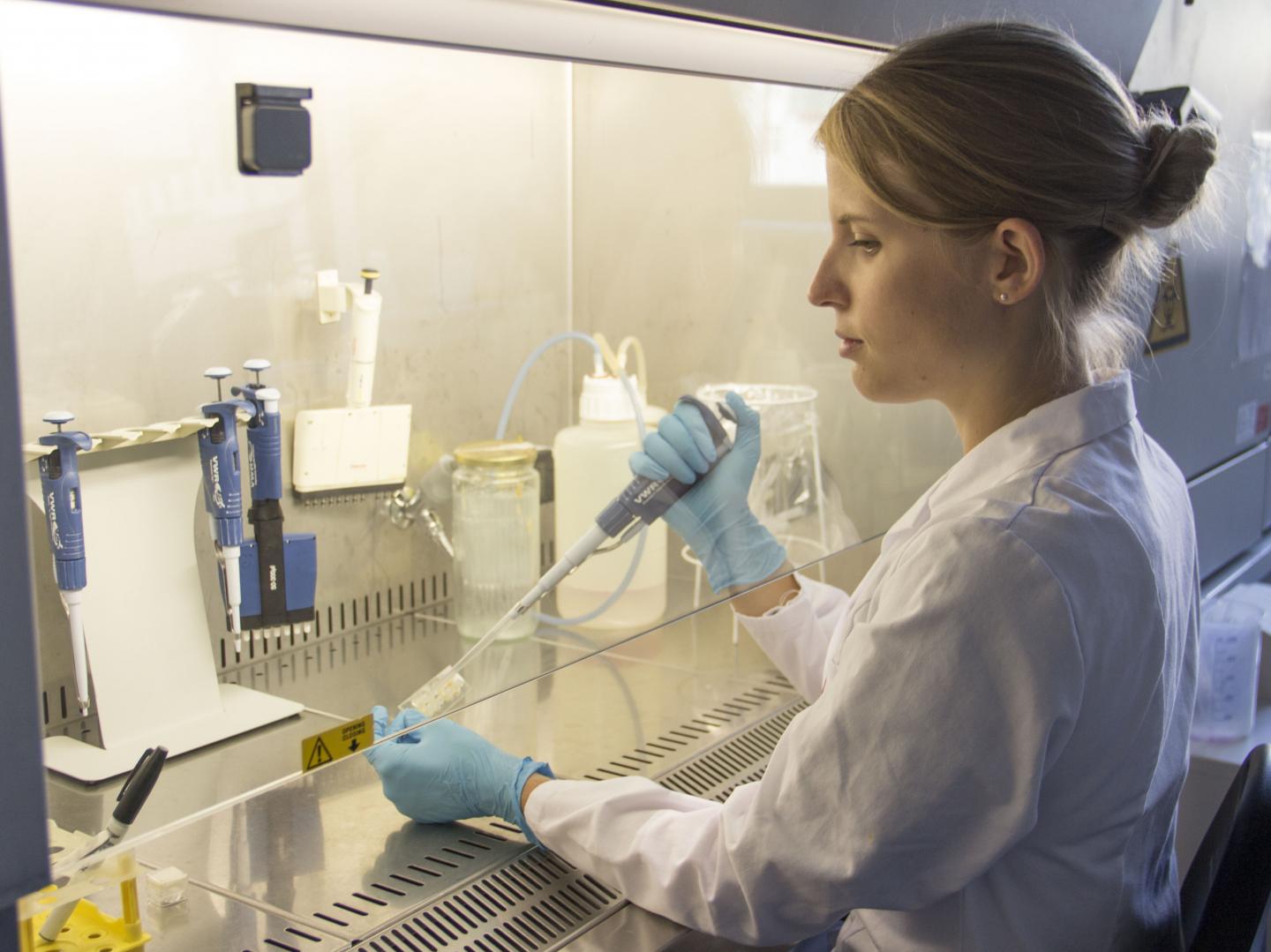 Denise Mandt in the lab. Source: TU Wien
The team developed a femtosecond laser-based, 3D-printing process for the creation of the artificial placenta. The new printing process created a customized hydrogel membrane directly onto microfluidic chips.
Researchers can use the device to learn more about vital areas of the placenta that have been unexplored until now, like how a mother’s disease or food intake fully affect the baby, which has been difficult to do until now.
"The transport of substances through biological membranes plays an important role in various areas of medicine", says Professor Aleksandr Ovsianikov of the Institute of Materials Science and Technology at TU Wien. "These include the blood-brain barrier, ingestion of food in the stomach and intestine, and also the placenta."
Replicating organs on compact chips to study the functions in a controlled lab environment is the next big thing in the medical field. This is the first time an artificial placenta has been created on a chip.
"Our chip consists of two areas - one represents the fetus, the other the mother", explains Denise Mandt, who worked on the project as part of her thesis. "We use a special 3D printing process to produce a partition between them - the artificial placenta membrane."
To create the placenta-on-a-chip, high-resolution 3D printing was developed to print materials which are later solidified with laser beams. This allows 3D structures to be created point-by-point with micrometer range resolution.
"In our case it involves a hydrogel with good biocompatibility," Aleksandr Ovsianikov explains. "Based on the model of the natural placenta, we produce a surface with small, curved villi. The placenta cells can then colonize it, creating a barrier very similar to the natural placenta."
"This 'organ-on-a-chip' technology is a revolutionary approach in biomedicine, which has generated a great deal of interest in clinical diagnostics, biotechnology and pharmaceutics in recent years," says Professor Peter Ertl, head of the cell chip research group. "The creation of human mini organs on a chip should allow the development of patient-specific therapeutic approaches, and also represents a vital method for replacing animal experiments."
The biological parameter placenta can now be studied more than ever before. The areas that can be studied include internal pressure, temperature, geometry, how drugs affect the placenta and more. The artificial placenta also allows researchers to watch how diseases progress through the placenta and the cure rates of diseases.
The first testing of the chip placenta showed that it behaves very similarly to a natural placenta. The artificial placenta allows small molecules to pass through and stops large molecules, which is also what a real placenta does.
The new model will be used by scientists and doctors to investigate aspects of nutrient transportation from mom to fetus and more.
A paper on the device was published in International Journal of Bioprinting.