Developing Designer Polymers on Demand
S. Himmelstein | August 13, 2018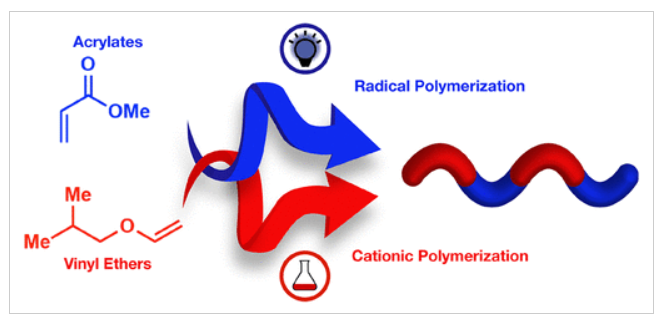 Schematic of the radical and cationic polymerization processes. Source: Cornell University
A new method for producing designer polymers uses light and chemical reactions to control how constituents come together to form materials with precise properties.
Polymers such as Teflon and nylon are composed in the laboratory of repeating units of just one kind of molecule that collectively gives the polymer its unique physical properties. Naturally occurring designer polymers, such as DNA, string different subunits together that can encode information or structural features.
Previous attempts by Cornell University researchers to replicate this natural process used two photocatalysts that worked when exposed to either blue or green light. The method wasn’t very selective, so the researchers set out to optimize the strategy.
The team used blue light to make one type of monomer bind, and an oxidant as a chemical stimulus to make another type of monomer bind. Switching between the light and the chemical additive allowed the researchers to selectively choose which subunit was added to the growing polymer molecule. Different patterns of polymer blocks were formed along the chain, the length of which was dependent on how long the stimulus was applied. This approach is expected to improve on-demand control over sequence, structure and architecture for many different polymers.
The study is published in ACS Central Science.