
Why Air Pollution from U.S. Manufacturing Declined During 1990-2008
S. Himmelstein | August 11, 2018Air pollution emissions from U.S. manufacturing declined by 60 percent during 1990-2008, a period in which manufacturing output grew significantly. The emission reduction is largely attributed to federal environmental regulations and attendant adoption of cleaner production methods, according to University of California-Berkeley researchers.
Newly available data on over 1,400 different products produced by U.S. plants during the study period were analyzed and combined with plant-level pollution emissions data. Reductions in overall emissions were then categorized into those that can be explained by changes in manufacturing output, changes in the types of goods produced or changes in production technologies.
Most of the decreases in emissions of important pollutants from manufacturing, such as nitrogen oxides, sulfur dioxide and carbon monoxide, were associated with changes in production technologies. To identify the key driver of this trend, the researchers quantified the importance of reductions in tariffs and other trade costs, improved productivity and environmental regulation in explaining decreases in air pollution emissions. The stringency of environmental regulation for manufacturing firms was shown to nearly double between 1990 and 2008. This increase, rather than improvements in manufacturing productivity or trade exposure, accounted for most of the decreases in pollution emissions.
The research is forthcoming in the American Economic Review.
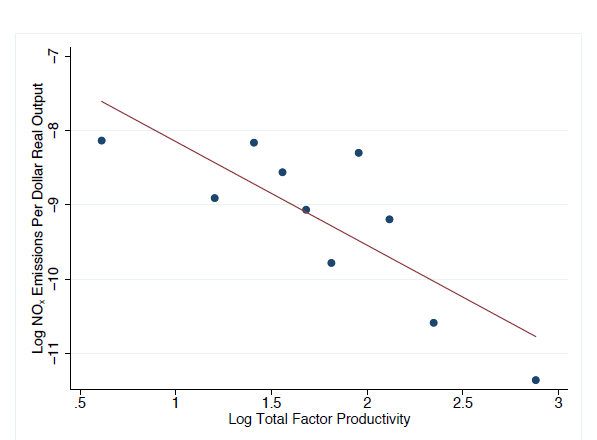 Plant level pollution intensity versus total factor productivity. Source: University of California-Berkeley

Very interesting article. I am a little unclear as to the meaning of "stringency of environmental regulation". Does this phrase mean that more environmental laws and standards were enacted, or that existing laws and standards were enforced, or a combination of the two? I would also like to know if the researchers measured the difference in plant CAPEX investments during this timeframe as an index of the degree to which companies either sought compliance voluntarily or did so in anticipation of being fined by the state and local EPA, or just wanted to adapt cleaner production methods in an effort to "get lean" and/or upgrade aging plants.
Finally the conclusion the author reaches in the last paragraph, that "stringency of environmental regulation for manufacturing firms was shown to nearly double between 1990 and 2008. This increase, rather than improvements in manufacturing productivity or trade exposure, accounted for most of the decreases in pollution emissions."...seems to contradict the author's opening statement that....
"The emission reduction is largely attributed to federal environmental regulations and attendant adoption of cleaner production methods"...which suggests that the two factors had an equal impact on the decline.