Build Your Own NASA Mars Rover
Peter Brown | August 02, 2018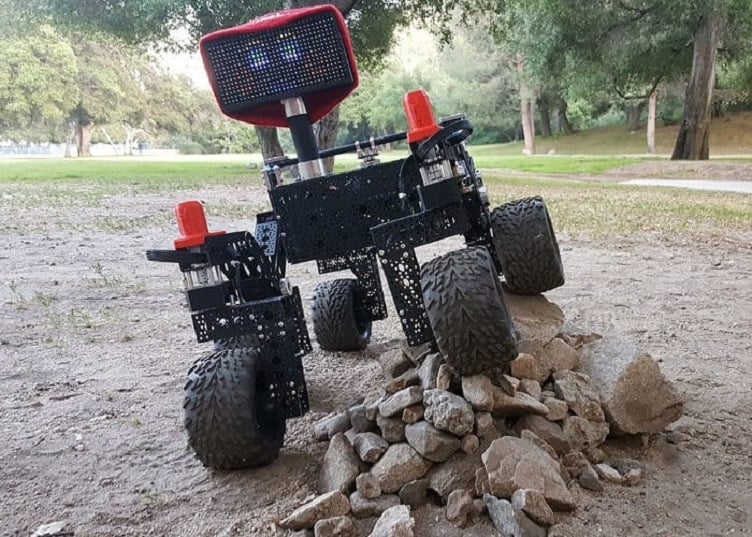 The NASA Rove-E rover was a previous model used to get students involved in robotics. Source: NASA JPL
The original Mars Curiosity rover was a marvel of technical ingenuity: tough enough to withstand the harsh conditions of the Red Planet while mobile enough to traverse the rocky terrain. It also gave us the first of numerous amazing photos of the planet from ground level.
Now, NASA is offering students, hobbyists, developers and robot enthusiasts a way to build a rover of their own using plans and instructions from JPL’s Open Source Rover project.
NASA’s Jet Propulsion Laboratory first offered an educational model of the rover, called ROV-E, which was a tool for high school and university students to bring innovations to classrooms, museums and school events to demonstrate robotics first-hand. However, that model was costly and complicated to build, so JPL went about designing a model that could be assembled using commercial-off-the-shelf (COTS) parts for under $2,500.
Enter the JPL Open Source Rover (OSR), a scaled-down version of the Curiosity featuring six-wheel steering capability with a Rocker-Bogie suspension, which allows all six wheels to continually be in contact with the ground while climbing over obstacles. The rover has a differential pivot feature that allows weight to be mechanically offloaded from one side of the rover to the other while climbing.
A Raspberry Pi was used as the brain of the rover because of its versatility, accessibility, simplicity and ability to add and upgrade personal modifications, JPL said. Bluetooth, Wi-Fi, USB and other connectivity options can be used to communicate with the Raspberry Pi and interfaced with the control system.
“We released this rover as a base model,” said Mik Cox, the project manager at JPL. “We hope to see the community contribute improvements and additions, and we’re really excited to see what the community will add to it.”
Because the OSR is open source, developers can decide what controllers to use or what add-ons to integrate such as USB cameras or solar panels or even attach science payloads. Users can also customize the power system and computation of the rover.
JPL said test builds of this rover have already been constructed inside classrooms, leading to different designs, ideas and solutions to common problems. JPL said it wants to see a fleet of rovers pop up in schools and workshops everywhere.
JPL has published the design of the OSR on GitHub, where anyone can download instructions and test plans for building their own rover.