Grid Management Recommendations for North American Utilities
S. Himmelstein | June 04, 2018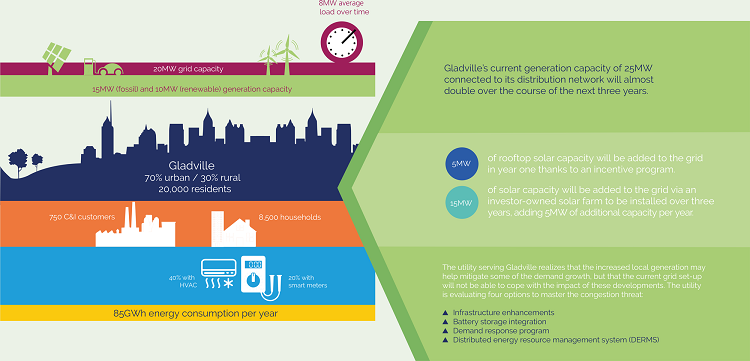 Four simplified scenarios that outline different approaches to the threat of congestion were modeled for the imaginary town of Gladville. Source: OMNETRIC Group
Utilities in North America need to better understand their customers’ behavior and evolving needs if they are to mitigate the risks of congestion in the distribution network. A new white paper from OMNETRIC Group finds that the growing penetration of distributed energy resources at the grid edge means that grid reinforcement techniques traditionally used to avoid congestion can no longer form the only remedy. Utilities must also incorporate digital solutions that expose and influence customer behavior and design new market models to achieve greater grid flexibility and stability in the future.
Congestion problems can be alleviated in five key ways:
● Increasing flexibility: distributed energy resources, while unpredictable, have the potential to enable utilities to operate grids more efficiently and economically. By adding software tools to the grid, utilities can influence the behavior of different stakeholders such as consumers and aggregators and smooth-out peaks in the system.
● Utilizing data-driven insight: improved integration of data from assets, sensors and meters across the distribution grid can allow utilities to combine operational and customer behavior-related insights to better avoid congestion.
● Sharing responsibility but retaining control: in the pursuit of flexibility, utilities will devolve some of their grid management responsibilities to third parties, but by setting the operating framework in which the ecosystem operates, utilities will continue to maintain ultimate responsibility for grid health.
● Establishing a value-based market: utilities can avoid congestion by transforming the market from a centrally fueled and controlled system to a network of localized grid components that produce, consume or manage energy and where every activity is evaluated according to the positive and negative consequences it has on the grid, and charged accordingly.
● Calling on regulators: in many ways, regulators have the potential to set the pace for utilities’ response to congestion. By becoming ambassadors and enablers of an age of customer centricity regulators will ensure the future success of utilities.
Simulations indicate that by taking an active approach to congestion management utilities have the potential to not only avoid the damaging impacts of grid congestion, but also to make considerable cost savings. Tackling congestion – either with infrastructure enhancements, battery storage integration, demand response or a distributed energy management system – will enable utilities to secure average yearly benefits ranging up to $20,000 per MW of connected distributed energy capacity, or $4.5 million over 10 years.