NASA Clean Rooms Found to Host Bacterial Intruders
S. Himmelstein | June 03, 2018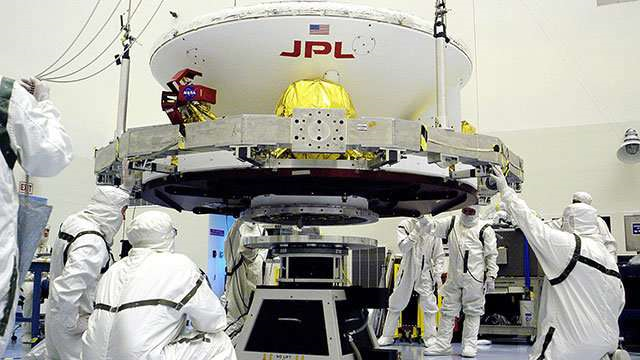 Engineers work on Opportunity in a cleanroom at Kennedy Space Center. Source: NASANASA spacecraft assembly plants are clean room facilities where a variety of planetary protection measures are implemented to minimize biological contamination of spacecraft. Cleaning procedures are essential to preventing contamination by Earth-based microorganisms, which could compromise life-detection missions by providing false positive results.
Despite these housekeeping protocols, molecular genetic analyses show that the clean rooms harbor a diverse collection of micro-organisms, or a spacecraft microbiome, that includes bacteria, archaea and fungi. Researchers have identified Acinetobacter, a genus of bacteria, as among the dominant members of the spacecraft microbiome.
How do these microbial agents survive in cleanroom facilities? To find out, a team from California State Polytechnic Institute analyzed several Acinetobacter strains originally isolated from the Mars Odyssey and Phoenix spacecraft facilities.
Under very nutrient-restricted conditions, most of the tested strains grew on and biodegraded the cleaning agents used during spacecraft assembly. Cultures grew on ethyl alcohol as a sole carbon source while displaying reasonable tolerances toward oxidative stress, which is associated with desiccating and high-radiation environments similar to Mars.
These strains were also able to biodegrade isopropyl alcohol and Kleenol 30, two commonly used cleaning agents. The cleaning products potentially serve as energy sources for the microbiome.
The findings indicate that more stringent cleaning steps may be needed for missions focused on life detection and highlight the need to use differing and rotating cleaning reagents that are compatible with the spacecraft to control the biological burden.
The research is published in the journal Astrobiology.