A Super Desiccant Based on Graphene Oxide
S. Himmelstein | May 31, 2018A new carbon-based desiccant that could enhance moisture control in applications as diverse as electronics, packaging and air conditioning. The graphene oxide-based material outperforms current drying agents, and is considerably more absorbent than silica gel, the industry standard.
Researchers documented a high water uptake capacity of up to 0.58 gram of water per gram of graphene 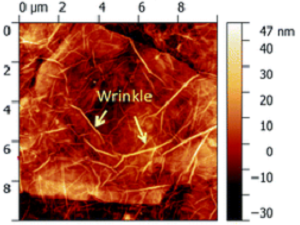 Atomic force microscopy images of graphene oxide showing 20 nm tunnel-like wrinkles. Source: The Royal Society of Chemistryoxide, which is markedly higher than silica gel as a conventional desiccant material. The adsorption and desorption kinetics of the material is five times higher than silica gel.
The extraordinary adsorption and desorption rates observed for the layered graphene oxide desiccant are attributed to high capillary pressure in the laminates and tunnel-like wrinkles on their surfaces — processes that had not previously been understood.
The ability to fine-tune the spaces between the layers of graphene oxide as desired will allow development of customized desiccants to control moisture across multiple applications.
The new desiccant can also discharge moisture at energy-saving low temperatures, enabling it to be used over and over again. By contrast, the heating required to regenerate conventional desiccants is often considered prohibitively expensive.
The research, which is published in the journal Chemical Science, was conducted by scientists from the University of New South Wales (Australia), CSIR — Central Electrochemical Research Institute (India) and Toyota Technological Institute (Japan).