Biologically Inspired Membrane Catches CO2 Emissions from Coal Plants
S. Himmelstein | April 11, 2018A biologically inspired membrane engineered by researchers from U.S. Sandia National Laboratories and the University of New Mexico offers a means to inexpensively reduce coal-fired power plant carbon dioxide emissions.
The water-based membrane is only 18 nanometers thick and incorporates natural enzymes to capture 90 percent of carbon dioxide released. The membrane is termed a “memzyme” because it functions as a filter but is near-saturated with an enzyme -- carbonic anhydrase -- developed by living cells over millions of years to help rid themselves of carbon dioxide efficiently and rapidly. The system meets U.S. Department of Energy standards by capturing 90 percent of power plant carbon dioxide production at a relatively low cost of $40 per ton.
A drying process called evaporation-induced self-assembly yields a close-packed array of silica nanopores designed to accommodate the carbonic anhydrase enzyme and keep it stable. The array, which may be 100 nanometers long, is first treated with a technique called atomic layer deposition to make the nanopore surface water-averse or hydrophobic. An oxygen plasma treatment is then administered, overlaying the hydrophobic surface to render the nanopores water-loving or hydrophilic, but only to a depth of 18 nanometers. A solution of the enzyme and water spontaneously fill up and are stabilized within the water-loving portion of the nanopores. This creates membranes of water 18 nanometers thick, with a carbonic anhydrase concentration 10 times greater than aqueous solutions made to date.
Due to the enzyme’s ability to rapidly and selectively dissolve carbon dioxide, the catalytic membrane has the capability to capture the overwhelming majority of carbon dioxide molecules it encounters from a rising cloud of coal smoke. The hooked molecules then pass rapidly through the membranes, driven solely by a naturally occurring pressure gradient caused by the large number of carbon dioxide molecules on one side of the membrane and their comparative absence on the other. The chemical process turns the gas briefly into carbonic acid and then bicarbonate before exiting immediately downstream as carbon dioxide gas. The gas can be harvested with 99 percent purity as other molecules pass by the membrane’s surface undisturbed. The enzyme is reusable, and because the water serves as a medium rather than an actor, does not need replacement.
The researchers suggest that the membrane’s arrangement in a generating station’s flue would be like that of a catalytic converter in a car. The membranes would sit on the inner surface of a tube arranged like a honeycomb, and flue gas would flow through the membrane-embedded tube, with a carbon dioxide-free gas stream on the outside of the tubes. Varying the tube length and diameter would optimize the carbon dioxide extraction process.
The separation process could increase the amount of fuel obtained by enhanced oil recovery using carbon dioxide injected into existing reservoirs. A slightly different enzyme, used in the same process, can convert methane to the more soluble methanol for removal.
The research is published in Nature Communications.
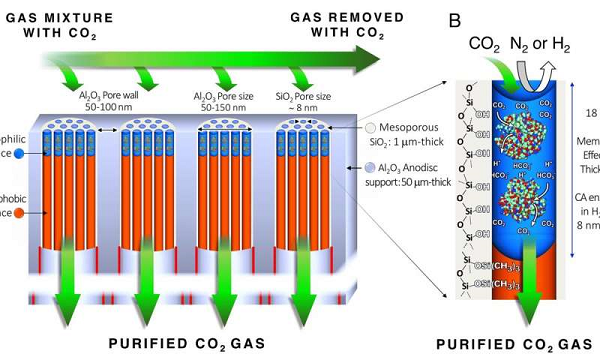 Enzymatic liquid membrane design and mechanism of carbon dioxide capture and separation. Source: Sandia National Laboratories