A Clean Route to High-quality Graphene Production
S. Himmelstein | April 10, 2018A new exfoliation strategy for preparing high-quality graphene and its composite addresses the challenge of an 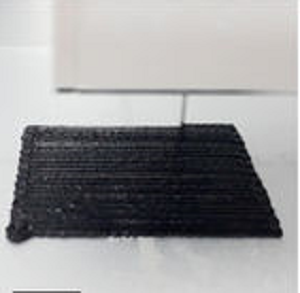 3D printing of graphene slurry at 10 wt%. Source: National University of Singaporeefficient process for large-scale production of graphene, and provides a route to sustainable synthesis of the material.
The 2D, one atom-thick material possesses unique electronic properties that can potentially be employed for a wide range of applications such as touch screens, conductive inks and fast-charging batteries. The inability to produce high-quality graphene affordably on a large scale, however, impedes graphene’s widespread adoption by industries.
The conventional approach to graphene production uses sound energy or shearing forces to exfoliate graphene layers from graphite, which are then dispersed in large amounts of organic solvent. Manufacturing one kilogram of graphene currently requires at least one ton of organic solvent, making the method costly and environmentally unfriendly.
The process devised by researchers from the National University of Singapore and Fudan University, China, consumes up to 50 times less solvent. Pre-treated graphite is exfoliated under a highly alkaline condition to trigger flocculation, a process in which the graphene layers continuously cluster together to form graphene slurry without having to increase the volume of solvent. The method also introduces electrostatic repulsive forces between the graphene layers and prevents them from reattaching themselves.
The produced graphene slurry can be easily separated into monolayers when required, stored for months or used directly to 3D-print conductive graphene aerogels, an ultra-lightweight sponge-like material that can be used to treat oil spills at sea.
The research is published in Nature Communications.