Autonomous Vehicles Could Shrink Parking Lots
Tony Pallone | March 29, 2018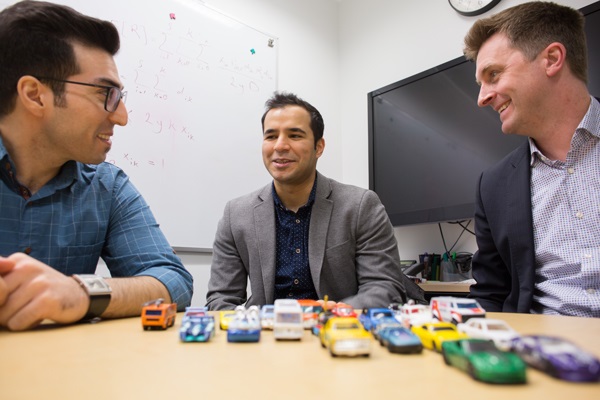 University of Toronto researchers designed an algorithm to optimize parking lot design for autonomous vehicles. Source: Roberta Baker.
Here’s some good news about autonomous vehicles (AVs): They could significantly reduce the amount of urban space devoted to parking lots.
According to a new study from University of Toronto Engineering, an AV parking lot could resemble a solid grid -- as opposed to the traditional “island” layout which leaves extra space for cars to pull in and out. As the animation below shows, outer cars can move aside as needed to let inner cars enter and exit. Space can further be conserved because AVs don’t need to open their doors in order to let human drivers in.
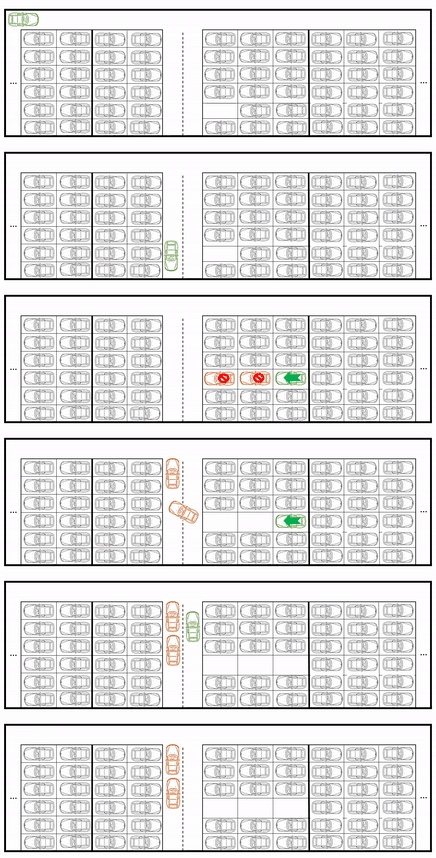 Animation illustrating AVs moving in and out of a solid parking grid. Source: Sina Bahrami.The U of T researchers wanted to determine the optimal size of the grid that would maximize storage, while also minimizing the number of moves required to extract any given car. “There’s a trade-off,” explained Mehdi Nourinejad, a civil engineer and recent PhD graduate who served as the study’s lead author. “If you have a very large grid, it leads to a lot of relocations, which means that it takes longer on average to retrieve your vehicle. On the other hand, if you have a number of smaller grids, it wastes a lot of space.”
To study various layout possibilities, the team created a computer model. An algorithm was employed to optimize parking lot design for various factors such as minimizing the number of relocations and maximizing the proportion of the lot that was used for parking versus lanes for relocation, entering or exiting.
Their analysis showed that a well-designed lot could accommodate 62 percent more cars than a conventional one; favorable lot dimensions, such as a square shape, could increase this number to as much as 87 percent. This would translate into much smaller parking lot footprints.
Additionally, the design of an AV lot is not fixed. “If demand changes — for example, if you need to pack more cars into the lot — you don’t need to paint new parking spaces,” said Sina Bahrami, a civil engineering PhD candidate. “Instead, the operator can just signal the cars to rearrange themselves. It will take longer to retrieve your vehicle, but you will fit more cars in.”
Civil engineering professor Matthew Roorda, the study’s senior author, hopes that municipal parking authorities will be able to use the researchers’ design approach to open up valuable urban spaces which are currently taken up by parking lots.
There is a catch, however: Although Roorda notes that a single lot could be comprised of both AV and non-AV areas, the team’s designs are optimized for parking lots populated exclusively by AVs. As to when the number of AVs on the road reaches the critical mass needed for AV-only lots to be a viable part of the urban landscape, that’s anyone’s guess.
The research is part of the iCity: Urban Informatics for Sustainable Metropolitan Growth project, an initiative of the University of Toronto Transportation Research Institute. It was published recently in Transportation Research.