Watch: Boosting Pharma Production with Green Catalysis Method
S. Himmelstein | February 21, 2018About 70 percent of pharmaceuticals are manufactured using palladium-driven catalytic processes that are either fast or efficient – but not both. A green chemistry method devised at North Carolina State University combines aspects of both to improve efficiency at a minimal cost of processing time.
The new reactions are used to connect carbons in small, organic molecules to create larger molecules for use in pharmaceuticals and other applications. Homogenous routes to achieve this dissolve palladium in solution and allow maximum exposure to the organic molecules, or reagents. This makes the process very fast but either wastes a lot of palladium or recovers it at high cost. In heterogeneous options, palladium is fixed to a hard substrate in a pack-bed reactor, and reagents are run through the reactor. This approach wastes very little palladium but is time-intensive.
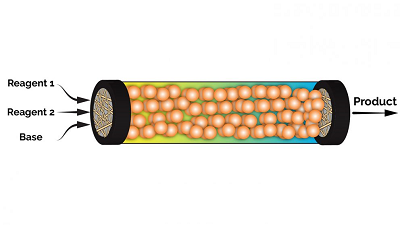 Diagram of the microsphere-packed, tubular reactor used in the new "pseudo-homogeneous" catalysis technique. Source: North Carolina State UniversityThe researchers engineered a pseudo-homogeneous catalysis method which is nearly as fast as homogeneous catalysis and preserves virtually all of the palladium. The new technique relies on novel, elastic silicone-chemistry-based microspheres developed by the research team using microfluidics. The microspheres are produced with a narrow size distribution to make them ‘loadable’ into a tubular reactor without clogging; conventional batch scale polymerization techniques result in elastomeric microspheres with a large size distribution that would clog the reactor when loaded.
Each silicone microsphere is loaded with palladium, after which reagents pass through the microsphere and interact with the palladium. The resulting pharmaceutical target molecules leave the microsphere again – but the palladium remains trapped in the microsphere.
The process proved much faster than heterogeneous techniques in proof-of-concept tests but was still marginally slower than conventional homogeneous methods. Efforts are underway to optimize microsphere properties to improve the reaction yield.
The pseudo-homogeneous technique also consumes nontoxic solvents, i.e., water and ethanol, while conventional homogeneous techniques use typically organic solvents, such as toluene, which are not environmentally benign.
The research is published in AIChE Journal.