Stable catalyst captures methane from gas engine exhaust
S. Himmelstein | August 28, 2023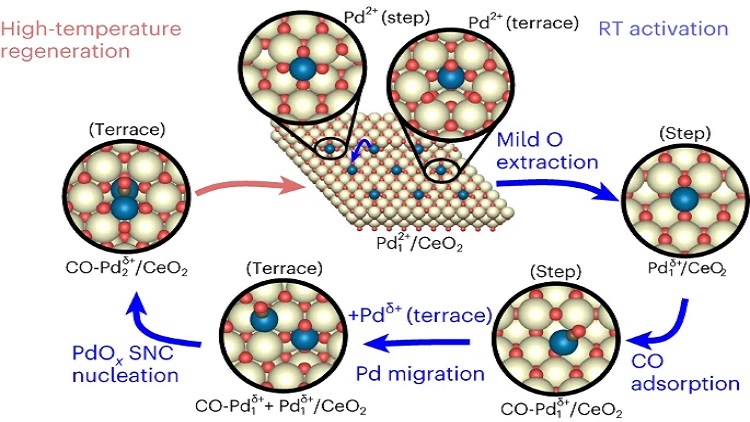 Simulated palladium/cerium oxide interfacial evolution in response to reaction conditions. Source: Nat Catal (2023), https://doi.org/10.1038/s41929-023-00983-8
A single atom catalysis route is being advanced to lower exhaust emissions of the powerful heat-trapping greenhouse gas methane. The catalyst based on a single or just a few palladium atoms was documented to remove 90% of unburned methane from natural gas engine exhaust at temperatures less than 350˚ C (662˚ F) while maintaining reaction stability at higher temperatures.
A catalyst based on single palladium atoms on a cerium oxide support efficiently removes methane from engine exhaust, even when the engine was just starting. The single-atom catalyst with the active metals singly dispersed on a support also uses every atom of the expensive and precious metals.
As reported in Nature Catalysis, trace amounts of carbon monoxide present in engine exhaust played a key role in dynamically forming active sites for the reaction at room temperature. The carbon monoxide enabled the single atoms of palladium migrate to form two- or three-atom clusters that efficiently break apart the methane molecules at low temperatures.
With an increase in exhaust temperatures, the sub-nanometer-sized clusters re-disperse to single atoms keeping the catalyst thermally stable. The catalyst performed effectively due to this reversible process, using every palladium atom the entire time the engine was running, including during cold starts.
Researchers from Washington State University, SLAC National Accelerator Laboratory, Stanford University and U.S. Argonne National Laboratory contributed to this development.