Material Designed by a Computer System — MIT's New Application of Artificial Intelligence
Abe Michelen | February 19, 2018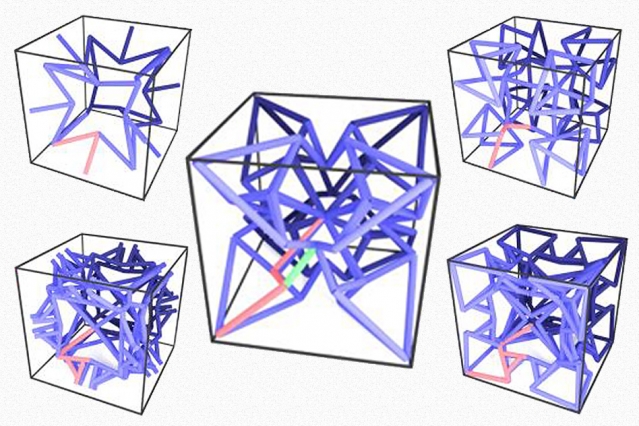 New software identified five different families of microstructures, each defined by a shared "skeleton" (blue) that optimally traded off three mechanical properties. Source: MIT
Material engineers design new materials by copying nature. If they find a desirable material feature by looking at the natural world, they can reproduce it — by trial and error, generally — using man-made materials once the microstructure of the material is determined.
Last week, a team of researchers at MIT’s Computer Science and Artificial Intelligence Department, led by associate professor Wojciech Matusik, announced the development of a computer algorithm that can be used to design new materials of a desirable structure, simply by entering the needed properties numerically. The result of their effort was published in Science Advances, where they describe a simple method to design materials with a combination of three different mechanical properties.
“We did it for relatively simple mechanical properties, but you can apply it to more complex mechanical properties, or you could apply it to combinations of thermal, mechanical, optical, and electromagnetic properties,” Matusik says. “Basically, this is a completely automated process for discovering optimal structure families for metamaterials.”
The software package automates all steps in the process, from measurements of properties to the correlation of geometries and properties. This automated system will allow for the design of microstructures with any type of properties. According to Matusik, this approach can be used in tandem with existing materials design, in addition to the designs inspired by nature.
“You can throw this into the bucket for your sampler,” Matusik says. “So we guarantee that we are at least as good as anything else that has been done before.”
A video explaining the details of the process was developed by MIT and is included in this writing.
The work was supported by the U.S. Defense Advanced Research Projects Agency’s Simplifying Complexity in Scientific Discovery program.