New Equation Developed Can Detect Weak Spots in 3D Printing Concrete Structures
Siobhan Treacy | February 14, 2018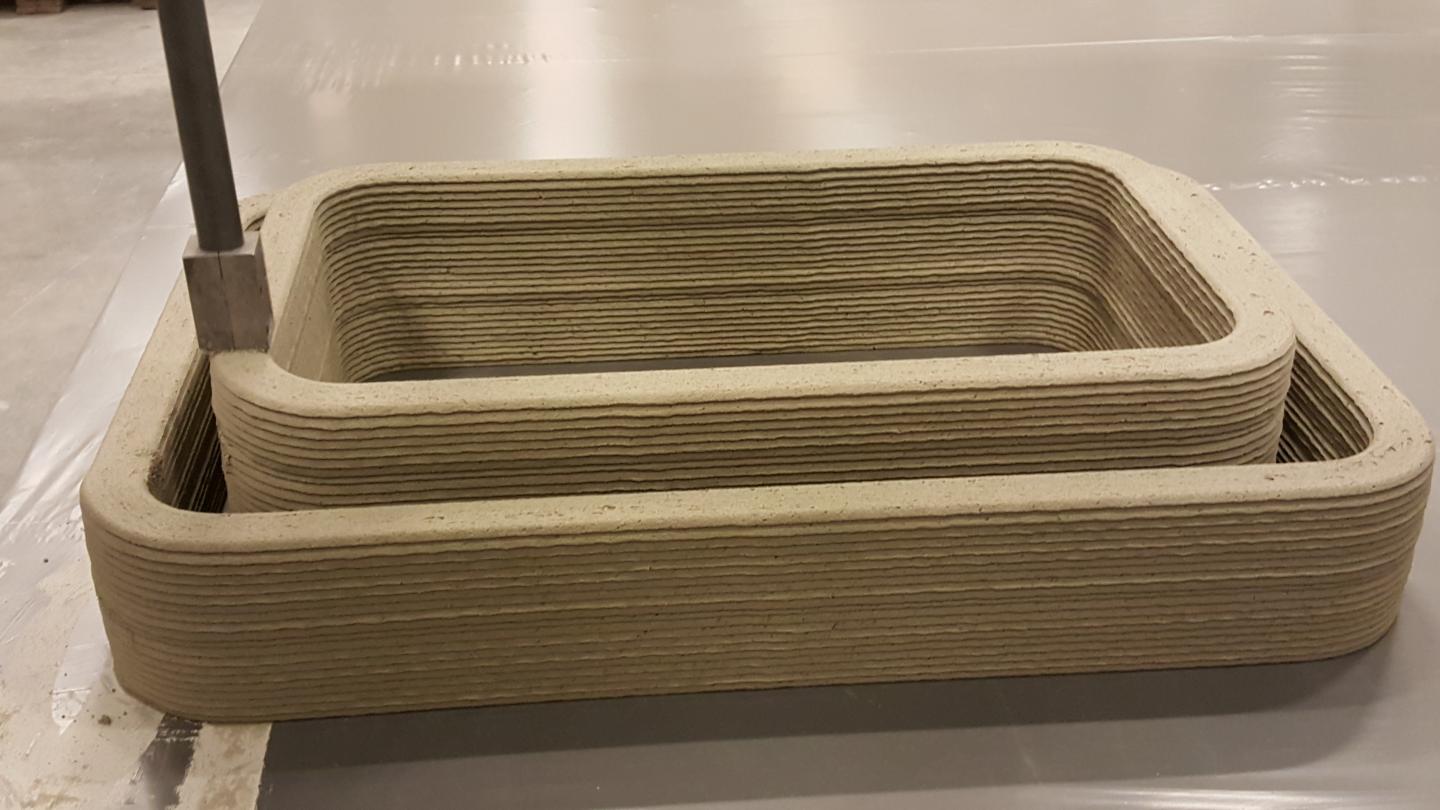 These are rectangular shapes printed at the TU Eindhoven 3-D-concrete printer. Suiker elaborated his equations for rectangular layouts like these. Source: Rob Wolfs/Eindhoven University of Technology
One of the major problems with 3D printed materials is they are usually soft during the printing process. This leaves the material weak to collapsing or falling over. Researchers from Eidhoven University of Technology have developed a model that will combat this problem.
Akke Suiker, professor in Applied Mechanics at Eindhoven, developed this new model. The formula can determine the dimensions and printing speeds that are required for any 3D printed object to stay stable during printing. This formula could soon become a common use in all areas using 3D printing.
Typically, it takes conventional concrete weeks to completely harden. 3D printed concrete doesn’t have the opportunity to take such a long time to harden. From the moment the material has been printed, it is bearing the whole weight of the rest of the layers on top of it. As a structure gets higher, more weight it put on the base layer and the more likely it is that the entire structure will fall apart.
Suiker developed an equation that can exactly calculate how quickly a 3D printer can lay down layers of any material while not compromising the structure. This equation can also calculate how to create a 3D printed structure while using as little material as possible along with what may cause any irregularities in the printing. It can even detect which wall is the most likely to collapse. There are 15-20 factors that affect the way a model is 3D printed. But by scaling his equations, Suiker brought that number down to five dimensionless parameters that produced an insightful model.
"The insights provided by the model create essential basic knowledge for everyone who prints 3D structures. For structural designers, engineering firms but also, for example, for companies that print thin-walled plastic prostheses of small dimensions, because that is where my equations also apply," said Suiker.
The paper on this research was published in the International Journal of Mechanical Sciences.