Shape-memory Technology Comes to Plastic Electronics
Tony Pallone | January 26, 2018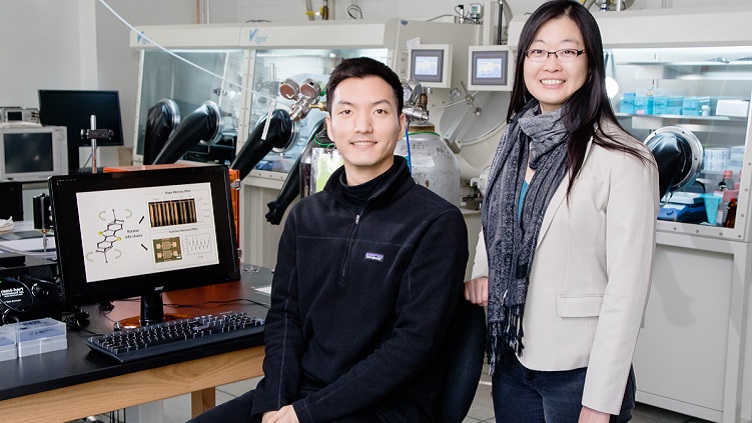 From left, grad student Hyunjoong Chung and Prof. Ying Diao. Sourece: L. Brian Stauffer.
Shape-memory technology is used in devices like expandable stents that open and unblock clogged blood vessels. Driven by heat, light and electric signals or mechanical forces, it works well with metal alloys -- yet remains elusive in synthetic organic materials because of their molecular complexity.
But researchers at the University of Illinois at Urbana-Champaign have identified a mechanism that triggers shape-memory phenomena in organic crystals used in plastic electronics. The discovery actually happened by accident: After the scientists unintentionally created large organic crystals, they decided to experiment on them with heat.
"We looked at the single crystals under a microscope and found that the transformation process is dramatically different than we expected," said graduate student and study co-author Hyunjoong Chung. "We saw concerted movement of a whole layer of molecules sweeping through the crystal that seem to drive the shape-memory effect -- something that is rarely observed in organic crystals, and is therefore largely unexplored."
In naturally occurring shape-memory materials, the molecules transform cooperatively – in other words, they all move together during shape change. The unexpected observation with the crystals led to the team’s interest in exploring the merger of organic electronics to shape-memory materials science.
"Today's electronics are dependent on transistors to switch on and off, which is a very energy-intensive process," said study co-author Ying Diao, a professor of chemical and biomolecular engineering. "If we can use the shape-memory effect in plastic semiconductors to modulate electronic properties in a cooperative manner, it would require very low energy input, potentially contributing to advancements in low-power and more efficient electronics."
The small molecular structure change can be amplified over millions of molecules to actuate large motion on a macroscopic scale, notes Diao. In addition to low-power electronics, the work could lead to advancements in medical electronics devices and multifunctional shape-memory materials.
Currently, the team is also experimenting with light waves, electrical fields and mechanical force, as well as exploring the molecular origin of the shape-memory mechanism. "We have already found that changing just one atom in a molecule can significantly alter the phenomenon," Chung noted.
The work is published in a recent issue of Nature Communications.