PEVs Should Be Considered in Future Electric System Planning, NREL Finds
Amy J. Born | January 24, 2018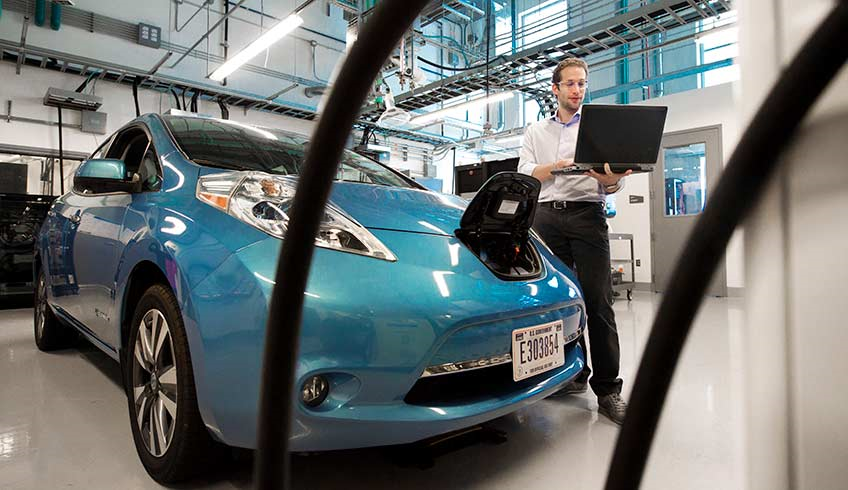 NREL engineer Matteo Muratori, author of the new Nature Energy paper "Impact of Uncoordinated Plug-in Electric Vehicle Charging on Residential Power Demand," said his research points to key areas where additional investigation is warranted. Source: Dennis Schroeder/NREL
Plug-in electric vehicles are on pace to make a serious dent in the market share of gas-powered vehicles over the next decade. What will all those charging cars mean for future electric systems? That is the question the U.S. Department of Energy’s National Renewable Energy Laboratory asked recently.
Matteo Muratori, a transportation and energy systems engineer at NREL, created a computer simulation to find out how in-home vehicle charging will impact the electric grid. “Previous research into the amount of energy required by homes hasn’t taken into account plug-in electric vehicles,” he said. “Given that more people are choosing to drive these types of vehicles and charging them at home, this additional demand should not be overlooked.”
The simulation found that a market share of up to 3 percent, about 7.5 million vehicles, has little impact on the aggregate residential power demand. However, it did reveal a problem when many people within a geographic area charge their vehicles at the same time — such as at the end of the work day. Muratori's paper states that this type of clustering effect, considered uncoordinated charging (meaning the utility has no control over when charging occurs), “will significantly increase the peak demand seen by distribution transformers and might require upgrades to the electricity distribution infrastructure."
The study also looked at the likelihood that, as the number of PEVs in a neighborhood increases, the number of owners opting for the faster, more powerful Level 2 charging option (over the slower Level 1 option) would increase as well. Two important potential outcomes of this are a decrease in reliability of distribution infrastructure to support the higher demand and the additional burden on the transformers that could shorten their expected life.
“Realizing the full benefits of vehicle electrification will necessitate a systems-level approach that treats vehicles, buildings and the grid as an integrated network,” said Johney Green Jr., NREL’s associate lab director for Mechanical and Thermal Engineering Sciences.
More research will likely be done looking closely at the charging requirements of Level 1 and Level 2 residential charging equipment, as Muratori suggests, as well as the overall necessity of keeping the grid "safe and resilient," according to John Farrell, NREL’s laboratory program manager for vehicle technologies.
Muratori's paper is published at Nature Energy.