Top 20 Mechanical Engineering Marvels
Tony Pallone | January 19, 2018It’s one of the world’s oldest professions, and its impact touches most every aspect of society. But no, it’s not illegal in most countries. I’m talking about mechanical engineering, the broad engineering discipline that has been around at least since the ancient Greeks – and could probably be said to have started with the invention of the wheel.
We thought it would be fun to look at images throughout mechanical engineering's long history, and reflect upon the profound influence it's had on industry, technology, transportation and more.
With acknowledgement to the American Society of Mechanical Engineers (ASME) for its long list of historic mechanical engineering landmarks, from which this list was derived, here are 20 chronological milestones.
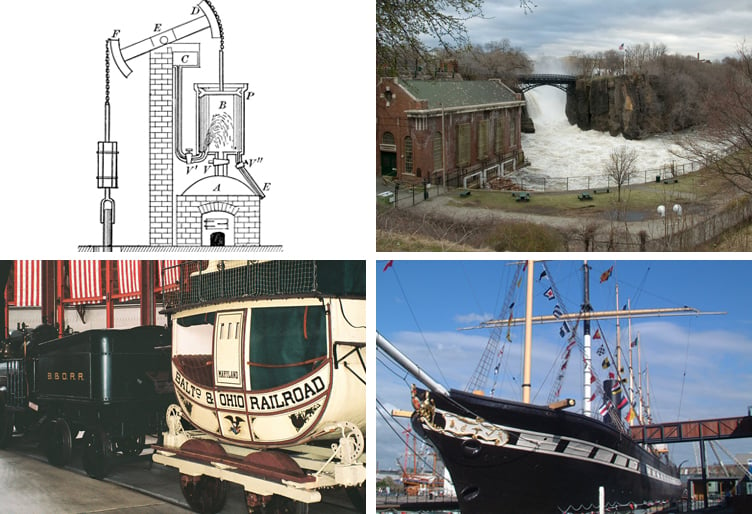 From top left: Newcomen engine; Great Falls; B&O (Source: James G. Howes); SS Great Britain (Source: mattbuck/CC BY-SA 3.0).
Newcomen Engine (1712): Direct descendant of the original atmospheric engine, the first practical device to harness steam to produce mechanical work. An improved version of the design led to the steam engine that fueled the Industrial Revolution. (Dartmouth Museum, Dartmouth, U.K.)
Great Falls Raceway and Power System (1792): First major U.S. water power system; basis for integrating urban planning with industrial development. (Paterson, New Jersey)
Baltimore & Ohio Railroad Old Main Line (1828): Also known as the B & O. First U.S. railroad in public service. (Baltimore, Maryland)
SS Great Britain (1843): World’s first iron-hulled, screw-propelled ship to cross any ocean; led to Britain’s leadership in maritime commerce. (Bristol, U.K.)
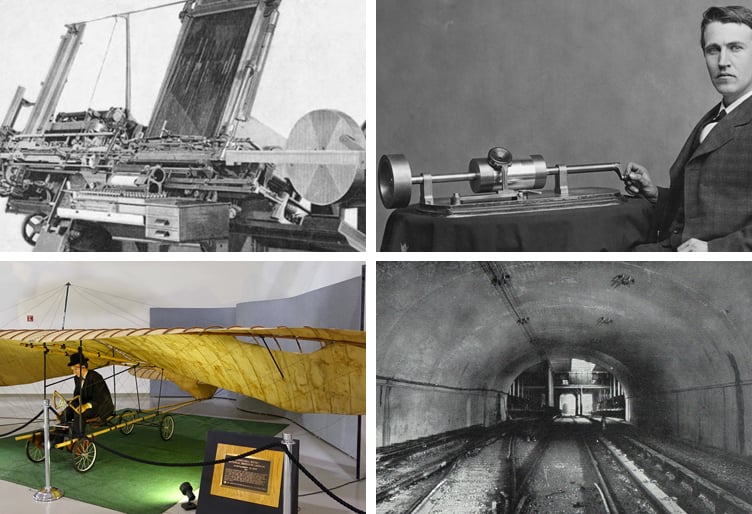 From top left: Paige Compositor; Edison with phonograph; Montgomery glider (Source: Daderot/CC0); IRT system.
Paige Compositor (1877): First U.S. typography machine to set, justify and distribute foundry type from a common case, using one operator. (Hartford, Connecticut)
Edison Experimental Recording Phonograph (1877): World’s first practical sound-recording machine. (West Orange, New Jersey)
Montgomery Glider (1883): First heavier-than-air, human-carrying aircraft to achieve controlled pilot flight. (Hiller Aviation Museum, San Carlos, California)
Interborough Rapid Transit System (1904): Original line represents the first fully electrically-signaled railroad in the U.S., and the first practical subway in New York City. (New York, New York)
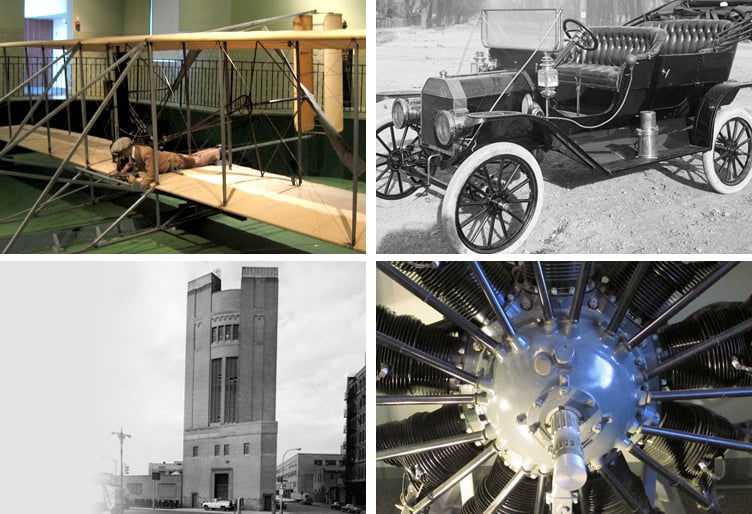 From top left: Wright Flyer; Model T; Holland Tunnel ventilation building; Wasp engine (Source: Sanjay Acharya/CC BY-SA 3.0).
Wright Flyer III (1905): First practical airplane. (Dayton, Ohio)
Model T (1908-27): Fifteen million Model T’s rolled off the assembly line. The last one is located in The Henry Ford. (Dearborn, Michigan)
Holland Tunnel Ventilation System (1920): An innovative ventilation system built into the world’s first long underwater tunnel designed for motor vehicles. (New York, New York)
Pratt & Whitney R1340 Wasp Engine (1925): This significant improvement to the radial aircraft engine design made commercial aviation viable. (Windsor Locks, Connecticut)
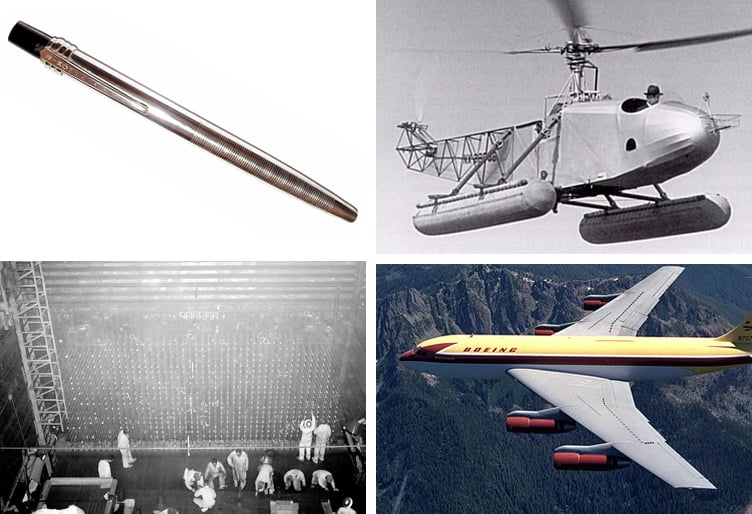 From top left: Birome (Source: Roberto Fiadone, Daniel Schwen/CC BY-SA 2.5): Sikorsky; Hanford B; Boeing 367-80.
Birome Ballpoint Pens (1938-48): The first ballpoint pens utilized the concept of quick-drying ink with a gravity-controlled flow. (Buenos Aires, Argentina)
Sikorsky VS-300 Helicopter (1939): First practical U.S. helicopter; pioneered the single-main-rotor concept. (Henry Ford Museum, Dearborn, Michigan)
Hanford B Reactor (1944): First U.S. plutonium production reactor placed into commercial operation. (Richland, Washington)
Boeing 367-80 (1954): Prototype for jet transport systems that established the economic feasibility of commercial air travel. (Steven F. Udvar-Hazy Center, Fairfax County, Virginia)
 From top left: IBM RAMAC; Shippingport; Shinkansen; Apollo space module (Source: James Humphreys — SalopianJames/CC BY-SA 3.0).
IBM 350 RAMAC Disk File (1956): World’s first computer storage device with random access to large volumes of data. (San Jose, California)
Shippingport Nuclear Power Station (1958): First U.S. commercial central electric-generating station to use nuclear energy. (Shippingport, Pennsylvania)
Tokaido Shinkansen (1964): World’s first high-speed railway, operating at speeds of 130-160 mph. (Tokyo, Japan)
Apollo Space Command Module (1968): Made possible safe transport to the moon and back. (Titusville, Florida)
All images: Via Wikimedia Commons. Where not indicated, images are public domain.