New Propulsion Technology for Nanorobots in 'Nanofactories'
Tony Pallone | January 20, 2018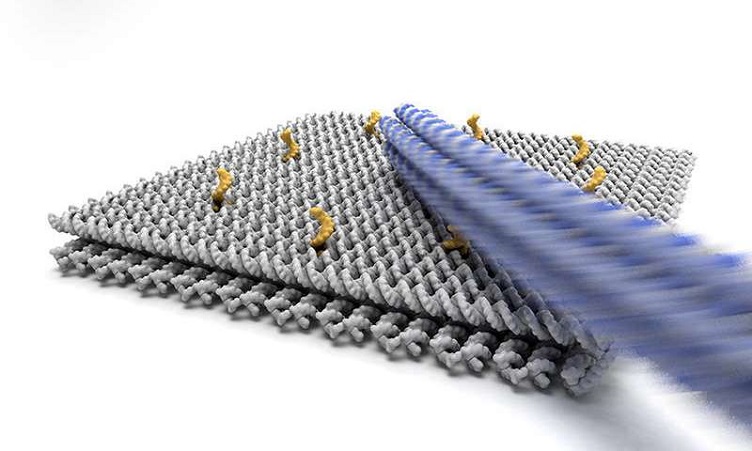 Electric fields drive a rotating nano-crane at speeds 100,000 times faster than previous methods. Image credit: Enzo Kopperger/TUM.
A novel electric propulsion technology for nanorobots developed by scientists at the Technical University of Munich (TUM) allows molecular machines to move a hundred thousand times faster than with the biochemical processes used to date -- fast enough to do assembly line work in molecular factories.
That’s right. The future of production will include "nanofactories" that can be used to analyze biochemical samples or produce active medical agents. There is already DNA-origami technology to produce the nanorobots -- what’s missing is speed. At present, the work takes minutes, or even hours – too long to be efficient on a molecular assembly line.
“Building up a nanotechnological assembly line calls for a different kind of propulsion technology. We came up with the idea of dropping biochemical nanomachine switching completely in favor of the interactions between DNA structures and electric fields,” explained TUM researcher Prof. Friedrich Simmel, head of the Chair of Physics of Synthetic Biological Systems.
It’s a simple principle -- DNA molecules have negative charges, allowing them to be moved by electrical impulses. So if DNA was used to make the nanorobots, problem solved.
As published in the journal Science, the researchers used miniature machines comprised of a 400-nanometer robot arm attached to a rigid, 55-by-55 nanometer base plate with a flexible joint. Several million arms were affixed to a glass substrate, and placed into a sample holder with electrical contacts designed specifically for the purpose. The tips of the arms were marked with pigment molecules so their motion could be observed with a fluorescence microscope. By changing the direction of the electric field, the researchers found they could arbitrarily alter the orientation of the arms and control the locomotion process.
“Thanks to the electronic control process, we can now initiate movements on a millisecond time scale,” Simmel said.
The new control technology is suited not only for moving around pigments and nanoparticles, but also for applying force to molecules. These interactions can be utilized for diagnostics and in pharmaceutical development, Simmel says.
“Nanobots are small and economical," he added. "Millions of them could work in parallel to look for specific substances in samples or to synthesize complex molecules – not unlike an assembly line.”