Skin Conformal Cardiac Electrodes Inspired by Grasshoppers
S. Himmelstein | January 16, 2018An improvement in health monitoring technology reported by researchers from Eidgenössische Technische Hochschule (ETH) Zürich promises electrodes more comfortable for the patient than metallic ones, and less irritating to the skin than gel-based electrodes. The new device is as elastic as skin and features a surface engineered to enable recording of high quality signals from the heart and brain.
The new electrode is composed of a non-irritant mixture of silicone rubber and conductive silver particles. The design of the surface structure was inspired by the grasshopper’s ability to walk on vertical surfaces. Grasshopper feet bristle with tiny pads which exert an adhesive effect — the van der Waals interaction — when they come into contact with another surface.
This microstructure was applied to the elastic material to form a skin-adhering electrode. The geometry at 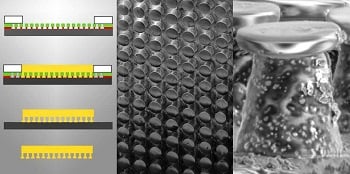 Fabrication process showing the two layers of paint in green and red, and the resulting shape of the electrode material in yellow (left); electron microscope image of the adhesive electrode surface with densely packed mushroom heads (center) and an individual head (right). Source: ETH Zurichthe microscopic level was shown to maximize the contact surface between skin and electrode, allowing signals to be recorded in very high quality.
Prototypes were developed in a cleanroom by coating a base layer with two different paints and covering it with a precisely perforated mask. Exposing the sample to light rendered the upper light-sensitive paint layer directly beneath the perforations soluble. This layer was further processed by immersion in a chemical solution for a defined interval to create a casting mold with inverted mushroom head-like pads. When cast, this produced a specifically structured adhesive electrode surface.
The electrodes were tested on a swimmer, as swimming is deemed a challenging discipline for performance monitoring by means of electrodes. The quality of the signals recorded by the new electrodes was significantly better than that of gel electrodes also worn by the subject.
Zürich’s lake rescue service has already shown interest in the new electrodes and is using them as part of an ongoing study.
Besides electrodes for recording cardiac output curves, the researchers have also developed an electrode for measurement of brain signals, or electroencephalography (EEG). The material combination is the same for both types of electrode, but the structures differ: the EEG electrodes do not need the adhesive microstructure, as they are attached using a cap. Instead, their surface is equipped with several pimples of two to four millimeters in height that allow contact with the scalp even through thick hair, eliminating the need for shaving and gel.