Prospecting for Silver in Your Laundry
S. Himmelstein | December 22, 2017The increasing use of silver nanoparticles as an antimicrobial agent on textiles poses ecological risks due to 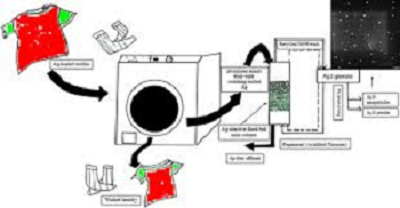 Schematic of silver recovery from laundry wastewater. Source: American Chemical Societyleaching during laundry and subsequent discharge in the environment. Recovery of some of this silver is possible, as demonstrated by University of Massachusetts researchers.
The recovery process is challenging because of low silver concentrations in the water, high concentrations of competing ions and uncertainty as to which exact forms of silver are present. Ion-exchange technology has been shown to be highly selective for silver, but the influence of detergent chemistry on recovery has not been studied, until now.
The researchers used a thiol-group functionalized ion-exchange resin in a fixed-bed column to remove silver from laundry wastewater and recover it as silver sulfide nanoparticles or high-purity powder. The effect of each detergent component on silver speciation and the resin performance was analyzed.
Silver was observed to exist as a positively charged ion, a form that will interact with several detergent compounds under certain conditions. These ions interact with negatively charged ions in the detergent at different pH ranges. The ion-exchange resin recovered as much as 99 percent of the silver, depending on the pH and concentration of the competing ions. When tested with detergent components and reused over five cycles, the resin was demonstrated to maintain the ability to remove silver. Addition of bleaching and water-softening agents negatively impacted the efficiency of the resin.