AI for Reliable Fusion Reactions
Tony Pallone | December 18, 2017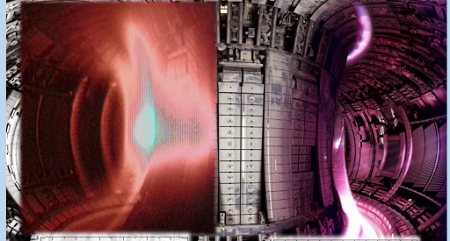 Side-by-side images show plasma disruption in JET (left) and a disruption-free experiment (right). Source: Eliot Feibush.Before scientists can effectively capture and deploy fusion energy, they must learn to predict major disruptions that can halt fusion reactions and damage the walls of doughnut-shaped experimental fusion devices called tokamaks. Timely prediction of disruptions — the sudden loss of control of the hot, charged plasma that fuels the reactions — will be vital to triggering steps to avoid or mitigate such large-scale events.
Researchers at the U.S. Department of Energy’s Princeton Plasma Physics Laboratory (PPPL) and Princeton University are employing artificial intelligence to improve predictive capability. Researchers led by William Tang, a PPPL physicist and a lecturer with the rank of professor in astrophysical sciences at Princeton, are developing the code for predictions for ITER, the international experiment under construction in France to demonstrate the practicality of fusion energy.
The new predictive software, called the Fusion Recurrent Neural Network (FRNN) code, is a form of deep learning — a newer and more powerful version of modern machine learning software, an application of artificial intelligence.
FRNN is a deep-learning architecture that has proven to be the best way to analyze sequential data with long-range patterns. Members of the PPPL and Princeton machine-learning team are the first to systematically apply a deep learning approach to the problem of disruption forecasting in tokamak fusion plasmas.
Using this approach, the team has demonstrated the ability to predict disruptive events more accurately than previous methods have done. By drawing from the huge data base at the Joint European Torus (JET) facility located in the United Kingdom — the largest and most powerful tokamak in operation — the researchers have significantly improved upon predictions of disruptions and reduced the number of false positive alarms. EUROfusion, the European Consortium for the Development of Fusion Energy, manages JET research.
The team now aims to reach the challenging goals that ITER will require. These include producing 95 percent correct predictions when disruptions occur, while providing fewer than three percent false alarms when there are no disruptions.
The process is highly demanding.
“Training deep neural networks is a computationally intensive task that requires engagement of high-performance computing hardware,” said Alexey Svyatkovskiy, a big data software and programming analyst in the Princeton Institute for Computational Science and Engineering.
The deep learning code runs on graphic processing units (GPUs) that can compute thousands of copies of a program at once, far more than older central processing units (CPUs). Tests performed on modern GPU clusters, and on world-class machines such as Titan — currently the fastest and most powerful U.S. supercomputer at the Oak Ridge Leadership Computing Facility — have demonstrated excellent linear scaling. Such scaling reduces the computational run time in direct proportion to the number of GPUs used — a major requirement for efficient parallel processing.
Princeton University’s Tiger cluster of modern GPUs was the first to conduct deep learning tests, using FRNN to demonstrate the improved ability to predict fusion disruptions. The code has since run on Titan and other leading supercomputing GPU clusters in the United States, Europe and Asia, and has continued to show excellent scaling with the number of GPUs engaged.
The researchers seek to demonstrate that this powerful predictive software can run on tokamaks around the world and eventually on ITER. Also planned is enhancement of the speed of disruption analysis for the increasing problem sizes associated with the larger data sets prior to the onset of a disruptive event.
Source: Princeton University