Taming tokamak plasma with AI
S. Himmelstein | March 26, 2024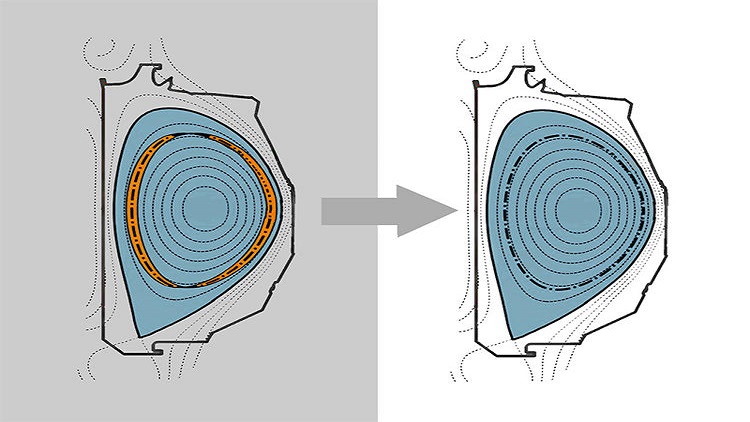 The power of AI was harnessed to predict and avoid the formation of a tearing instability (left), which could quickly result in plasma disruption and the termination of the fusion reaction. Source: Nature volume 626, pages746–751 (2024)
The attainment of fusion reactions in tokamak systems is currently limited by the instabilities arising in the superheated plasma underlying the power-producing process. The capacity to contain a specific type of disturbance has been demonstrated by researchers from Princeton University and the U.S. Department of Energy’s Princeton Plasma Physics Laboratory.
Tearing mode instabilities are characterized as disruptions in which the magnetic field lines within a plasma break and open an opportunity for the plasma’s subsequent escape. The preventive remedy described in Nature is based on a deep neural network capable of predicting the likelihood of a future tearing instability based on real-time plasma characteristics. The neural network was used to train a reinforcement learning algorithm to identify optimal strategies for controlling plasma.
When applied to experiments at the DIII-D National Fusion Facility in San Diego, California, the artificial intelligence (AI)-based controller was documented to forecast potential plasma tearing up to 300 milliseconds in advance. This proved to afford sufficient time for the controller to change certain operating parameters and avoid a tear within the plasma’s magnetic field lines, which would upset its equilibrium and lead to a reaction-ending escape.
The next goal is to record more evidence of the AI controller in action at the DIII-D tokamak, and then expand the system to function at other tokamaks, including the International Thermonuclear Experimental Reactor now under construction.