Grants Boost Bay State's Energy Storage Goals
David Wagman | December 11, 2017 Massachusetts statehouse.
Massachusetts awarded $20 million in grants to 26 projects to help develop the Commonwealth’s energy storage market. The projects will draw an additional $32 million in matching funds.
The grants were awarded as part of the Energy Storage Initiative (ESI) Advancing Commonwealth Energy Storage (ACES) program, funded by the Department of Energy Resources (DOER) through Alternative Compliance Payments (ACP) and administered by the Massachusetts Clean Energy Center (MassCEC).
The announcement was made at UMass Memorial - Marlborough Hospital. The critical care facility will use funding received under the grant program to integrate a 400 kw solar canopy and energy storage system, reduce energy use and costs, shave its peak demand and increase its overall resilience.
A study released in September 2016 analyzed the benefits of 10 specific-use cases to evaluate how storage economics vary by business model, market involvement and location.
It said that 600 MW of energy storage technologies could be deployed on the Massachusetts grid by 2025. If deployed, the technologies could provide over $800 million in cost savings to ratepayers and reduce greenhouse gas emissions by 350,000 metric tons over 10 years.
In June, DOER announced a 200 megawatt hour (MWh) energy storage target for the state’s three electric distribution companies to achieve by 2020. The projects awarded under the ACES program represent a total of 32 MW and 85 MWh of energy storage capacity, of which 16 MW and 45 MWh are within electric distribution company territory. Massachusetts currently has approximately 4 MW and 7 MWh of advanced energy storage installed.
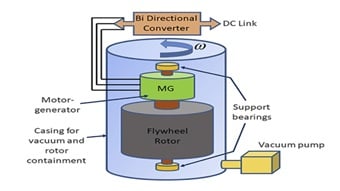
The state says that energy storage technologies include batteries, flywheels, thermal storage and pumped hydroelectric storage, which are capable of storing energy during off peak periods when costs are low and then make energy available during peak periods when costs are higher. Energy storage also makes it possible to increase the effectiveness of renewable energy sources, like solar, by storing energy generated during the day for use at night. Energy storage can also provide power during outages, result in greenhouse gas reductions and increase the electric grid’s overall reliability and resilience.