Smart Sensors Hit the Road
Winn Hardin | March 24, 2015In January, Engineering360 examined infrastructure resiliency and sustainability in the article "Can a Rating System Ensure Infrastructure Sustainability?". In a companion article, “Engineering Solutions that Support Resilient Infrastructure,” Engineering360 considered efforts to use recycled and even organic materials in infrastructure projects to help improve their sustainability. This article will look at how electronics sensors are playing a role in monitoring U.S. infrastructure.
Sustainable infrastructure comes not just from the materials but also the technology supporting it. The Laboratory for Intelligent Systems & Technologies (LIST), which is a part of the University of Michigan Civil and Environmental Engineering Department, is looking at sensing, computing and actuation technologies to improve the resiliency of civil infrastructure.
Wireless sensors embedded in various infrastructure systems like bridges and pipelines would allow users to measure their performance in real time and use local and cloud computing to process the large amounts of data collected.
“In some instances, we can actually control or configure an infrastructure system so as to prevent it from being damaged, or, if it is damaged, to ensure that it still has functionality," says Jerome Lynch, professor and director of LIST. Examples include controlling buildings and bridges during earthquakes with actuators, traffic through the use of dynamic pricing of tolls and water distribution systems through the use of valves and pumps. To validate the performance of wireless sensing unit prototypes in realistic civil structures, validation studies are performed on bridges. In collaboration with researchers from Los Alamos National Laboratory (LANL), the Alamosa Canyon Bridge was instrumented with microelectromechanical systems (MEMS) accelerometers and wireless sensors. The Guemdang Bridge in South Korea also was instrumented with a network of 14 wireless sensing units.
The technologies examined at LIST address the limitations of current infrastructure monitoring techniques, most of which are wired.
“Not only is the wiring itself expensive, it can be a failure point in the system," Lynch says.
Furthermore, wired systems collect less data than their wireless sensor counterparts, which are low-cost and compact. Instead of tens of traditional wired sensors in an infrastructure system, “you can deploy hundreds if not thousands of wireless sensors," Lynch says.
The result is ever-growing volumes of data. Research from LIST examines ways to automate processing all of this data. Doing so will enable infrastructure managers to make more efficient decisions by learning how much life is left in a given structure and how long it can go without further deterioration, then determining the most cost-effective way to resolve the problem.
Hesitancy
Even so, many stakeholders remain hesitant to invest in wireless sensors, “largely because they have not seen a clear path for better decision-making," Lynch says.
Other challenges include how to best scale up the wireless technology and how to power the electronics used in sensors and actuators. Lynch says, “There is really no perfect solution yet for providing autonomous self-powered devices that can operate for decades in this field."
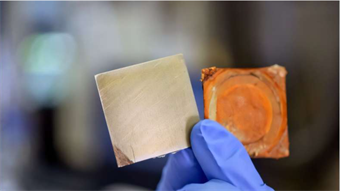
Researchers at the Michigan State University hope to change that with their study of piezo-floating-gate (PFG) sensors. The self-powered devices, which can be embedded inside of structures such as bridges and pavement, harvest their operational energy directly from very small variations in mechanical strain. They also can autonomously compute the cumulative stress and strain patterns experienced by the structure and store the measurement in a non-volatile memory.
“The key differentiator of this technology compared to others is its ability to operate without batteries and self-power itself at strain levels not possible using other existing methods," says Shantanu Chakrabartty, associate professor in the department of Electrical and Computer Engineering at Michigan State.
One fundamental barrier to the PFG sensor is its inherently passive nature. This means that retrieving the data requires aradio-frequency identification (RFID) or a wireless interface. This requires end users to decide when to collect the data.
Chakrabartty says that although this feature might not impede condition-based maintenance applications, “it could be a limitation for sensing applications where data needs to be collected continuously in real-time."
Whether they are refining uses for recycled content, developing smart sensors to monitor bridge performance or creating alternatives to traditional infrastructure materials, engineers and researchers are on a quest to develop more sustainable and resilient infrastructure.