Eye Implant Delivers Glaucoma Medication
S. Himmelstein | November 29, 2017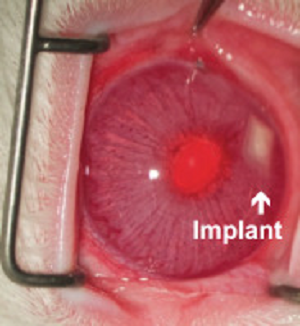 The biodegradable implant shown in the eye of a rabbit. Image credit: Jean Kim/Desai LabGlaucoma affects an estimated 60 million people worldwide but is one of the most easily treatable diseases, typically only requiring medicated drops. However, eye drops are one of the most difficult drug delivery methods, as patient adherence can be a problem. Application can be inefficient, especially when the drops miss the desired target location.
A tiny implant that can deliver medication directly to the inside of the eye can simplify administration of glaucoma drugs, which would be particularly valuable for aging patients. The device, which is about 3 mm2 in size, consists of a biodegradable chamber that can be filled with the appropriate medication.
Researchers from the University of California San Francisco used a biodegradable film to encase the eye drop formulation. The drug delivery regimen is expected to last for six months. The drug-releasing devices were implanted in animal models and eye pressure was measured on a weekly basis for 24 weeks. Beyond some rare and minor complications, the implant effectively reduced eye pressure in the animals for the duration of the study.
“While there have been important advances in eye drop formulations, our device substantially reduces the burden of patient compliance in a safe and effective way,” said Tejal Desai, Ph.D, chair of the department of bioengineering and therapeutic sciences.
“Next steps will involve scaling up, developing device fabrication procedures that comply with current good manufacturing practices, and testing the device in larger animals, before moving on to clinical trials.”
The research is published in the Journal of Controlled Release.