Automated System Measures Automotive Cable Properties
S. Himmelstein | November 17, 2017An automotive assembly component rarely regards it's wiring. Cars currently contain up to 3 km of complex wiring for power and data transfer to headlights, onboard computers and different motors and sensors. Cables must be installed in a finite space without tangling or damaging them, which could undermine vehicle performance and safety.
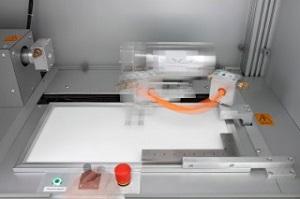 The system sets the bending radius to realistic values matching those encountered in vehicle applications. (© Photo Fraunhofer ITWM)Car manufacturers have relied on the IPS Cable Simulation software for this purpose, jointly developed by the Fraunhofer Institute for Industrial Mathematics ITWM and the Fraunhofer-Chalmers Research Center FCC. The software can simulate the best way to lay cables in a vehicle, in real time, but requires input of physical parameters for bending, torsion and tension stiffness. Determining these values is a time-consuming process based on sending cable samples to a laboratory to undergo measurements using several different test systems.
Now customers can have the datasets required within as little as three hours. A new, highly automated measurement system developed by researchers at Fraunhofer ITWM makes this possible: MeSOMICS (Measurement System for the Optically Monitored Identification of Cable Stiffnesses).
“Our solution enables customers to test cables on their own premises, which not only saves a lot of time but also money,” said Dr. Ing. Michael Kleer, a research scientist at the Fraunhofer Institute in Kaiserslautern.
The tests run automatically and can be carried out by employees without any special training. Just clamp the cable in the test apparatus and start the measurement process. Inside the machine, the cable is deformed in a specific measurement cycle, and the required forces and moments are recorded. The result is delivered to the user in the form of a photo of the bent cable, overlaid with the theoretical curve of the bending line for the determined stiffness value. The user can see at first glance whether the parameters are realistic. The stiffness values are also provided as a dataset that can be directly read into the simulation program.
Another special feature of the machine is that it emulates the actual bending conditions of the cable during installation -- the bending curvature is increased to match the reality of vehicle applications. The MeSOMICS system is already commercially available as a scalable solution that can be adapted to each customer’s needs.