PC-based Controls Take on the Reigning Champ
Dan Hebert | September 30, 2014 Industrial PCs are coming on strong, fueled by advances such as multi-core processing, Ethernet-based I/O and embedded operating systems.
The programmable logic controller (PLC) and its direct descendant, the programmable automation controller (PAC), have ruled the roost for decades in industrial control applications.
But industrial PCs (IPCs) are coming on strong, fueled by advances such as multi-core processing, Ethernet-based I/O and embedded operating systems.
The first step in comparing these technologies and showing where each shines is defining what constitutes a PC-based controller or an IPC, sometimes a difficult task.
“PC-based control and IPCs have a much higher market penetration rate than indicated in our surveys as quite a few of the mid-ranged to high-end PLC products nowadays are actually using PC-based technology,” says Jan Zhang, associate director of Industrial Automation-APAC for IHS Technology.
The PC-based technology that Zhang refers to includes the main processor and often the operating system, the heart of the high-end PLC or PAC. So, a PLC or a PAC can be similar to an IPC, so much so that it often is distinguished only by how a vendor markets a particular product.
With that in mind, the current share of the industrial control hardware market for IPCs is 16%, according to IHS Technology. That share is projected to grow to 18% by 2017. For PLCs and PACs, the current share is 46% and is projected to shrink to 44% by 2017. The remainder is claimed by distributed control system (DCS) hardware and product integrated controllers, with market shares of 33% and 5%, respectively, and projected to be the same in 2017.
The second step is defining what constitutes “control.” Many sources rely on a broad definition, which includes real-time control of I/O, operator interface, data handling, networking and all other tasks related to industrial control of a machine or process.With these definitions in mind, there’s little question that the PLC/PAC is in the lead, although the IPC is gaining market share.
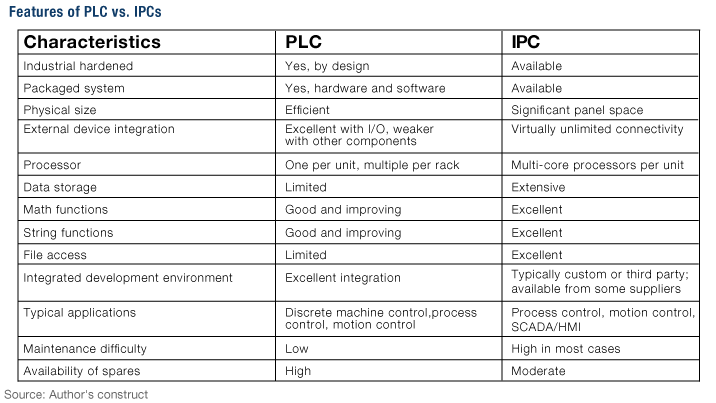 Comparing features and attributes of PLCs and IPCs.
For most applications, customization does not rate well when up-front engineering, programming time and long-term support are considered. But for applications where hardware costs must be minimized and performance maximized, it can make sense to spend more on the engineering and support usually required by an IPC.
Of course, some suppliers provide IPCs with a complete range of hardware and programming software, much like a PLC. But in this case, prices likely will rise above what is found when using a standard IPC, though generally not to PLC levels. An IPC is often selected when performance requirements dictate its use, particularly when it comes to data handling and storage. An IPC can be specified with extensive data storage capability, and it can quickly read and write data from and to files.
In applications where significant data storage and logging are needed, the IPC frequently shines. The IPC can move among data storage mediums from solid-state to hard drives, allowing users to optimize data storage and retrieval.
Another area where IPCs shine is in terms of performance, particularly when the IPC is equipped with a field-programmable gate array (FPGA) for hardware-based processing of specified I/O points. For esoteric networking requirements, an IPC may be the best choice as it will provide one of the widest ranges of connectivity options. In the past, IPCs were often regarded as not being stable or robust enough for the factory floor. But with advances in solid state drives and heat transfer, moving parts can be eliminated from IPCs.
From a controller and operating system standpoint, current IPC designs give up nothing to the PLC in terms of reliability.The old fear of the “blue screen of death” is increasingly a thing of the past. Any operating system, even a PLC’s, has the opportunity to lock up, but today this is usually more of a programming and sequencing issue than an operating system fault. Using current technology, IPCs running real-time embedded operating systems can have the same reliability as a PLC.
With a PLC, I/O, ancillary hardware and programming software are provided and supported by the vendor for the long term. This can drive up cost and lowers the price/performance ratio as compared to the IPC, but will ease deployment and support. This type of modular hardware support is an integral part of the design. I/O capability is built into the controller-based rack or bus system. As needs change, additional local or remote I/O are available as part of the modular and vendor-supplied offering, and the hardware and software will be available as part of the same control architecture.
Most PLC vendors are moving toward an integrated control and human machine interface (HMI) environment using a single tag name database, as is available in IPC-based systems. Once variables and I/O are defined in the PLC programming software, the variable can be used immediately by the HMI software. This is a valuable feature for any control system.
PLCs also tend to shine in low-end applications where the power of an IPC would be wasted. So long as they meet performance requirements, they will almost always be easier to deploy and support.
The features, functions and capabilities of both the PLC and the IPC are merging. Both are suitable for a wide variety of industrial automation applications such as discrete control, process control and motion control. Both provide advanced programming features such as multitasking, subroutines, string handling and floating-point math.
Some high-end PLCs and all IPCs also allow programming in .NET, C++, script or other standard programming languages. All PLC and some IPC manufacturers have a good handle on long-term availability of components. They publish lists of part number lifetime expectations and a timeline of parts obsolescence. This alleviates the fear of not being able to replace a failed part long after it was purchased. Even so, careful selection is a must when an IPC is used because vendor support policies vary widely.
Although both the PLC and the IPC have their strong points, the PLC will likely keep its lead for some time due to its advantages in ease of deployment and support. In the long term, high-end PLCs and IPCs may become nearly indistinguishable, as both borrow strengths from each other to meet end-user needs.