Fracking UK: Challenges in Developing Shale Gas Resources
Mike Farish | March 17, 2015The technique of hydraulic fracturing or "fracking" to release reserves of natural gas in underground shale formations is well-established in the U.S.However, in the UK the situation currently stands in stark contrast. Despite the existence of appropriate shale formations underneath large parts of the country, the amount of shale gas that has been recovered so far for use as an energy resource is negligible.
Why this should be so is not easy to pinpoint though it is impossible to exclude negative publicity about the alleged dangers of fracking, which has led to at least one anti-fracking demonstration at a site where exploratory drilling was taking place.
An ironic aspect of this state of affairs, though, is acknowledged by Ken Cronin, chief executive of UK Onshore Oil and Gas (UKOOG), an association representing roughly 60 companies which is involved in the search for onshore hydrocarbons in the UK. He says that there is nothing unusual about the use of fracking within the UK and that the technique has been used at about 200 different onshore sites in the country over the last 30-40 years.
Cronin was a key speaker at the UK Shale Gas: The Engineers’ Summit held in February 2015 in London, hosted by the The Institution of Mechanical Engineers (IMechE), to allow discussion among relevant professionals on the basis of real experience. Cronin says that the basic procedure to access shale gas reserves includes drilling first a vertical shaft, followed by a series of horizontal radials and then carrying out fracking along those radials.
He says this is, in principle, no different than what has been done previously, save for the higher volumes and pressures for the fracking mixture injected into wells. What is different in the case of shale gas, though, is the depth at which fracking will be carried out, roughly 2,500-3,000 meters below the surface. That compares with about 1,000 meters for more conventional sources.
Engineering Challenges
At present, says Cronin, total UK gas consumption is some 3 trillion cubic feet (tcf) per year, of which about 50% is imported. That proportion could rise to 75% by 2030 unless greater domestic resources are identified and exploited. What in engineering terms would be necessary to achieve domestic production?
One answer to that question was provided by Andrew Quarles, technical director of hydrocarbon extraction company Cuadrilla Resources. He says that the key defining characteristic of shale gas is the extremely low permeability of the rock formations that contain it. In this instance the degree of permeability involved is in the range 0.1-0.0001mD; in layman's terms the permeability ranges from the equivalent of sidewalk cement to granite. What is necessary to release the gas is to force into the shale at high pressure a mix of water, chemicals and fine silica sand that opens up multiple minute channels in the rock and then holds them open so that the gas can escape. The grains of sand, he says, can be as small as 0.053-0.422mm in diameter, while the pressures can be as high as 12,500hhp.
Cuadrilla is, in fact, the only company so far to carry out, exploratory fracking for shale gas in the UK. Unfortunately, when it did so the occasion seemed to substantiate the worst fears of the anti-fracking lobby because it resulted in two small earth tremors.
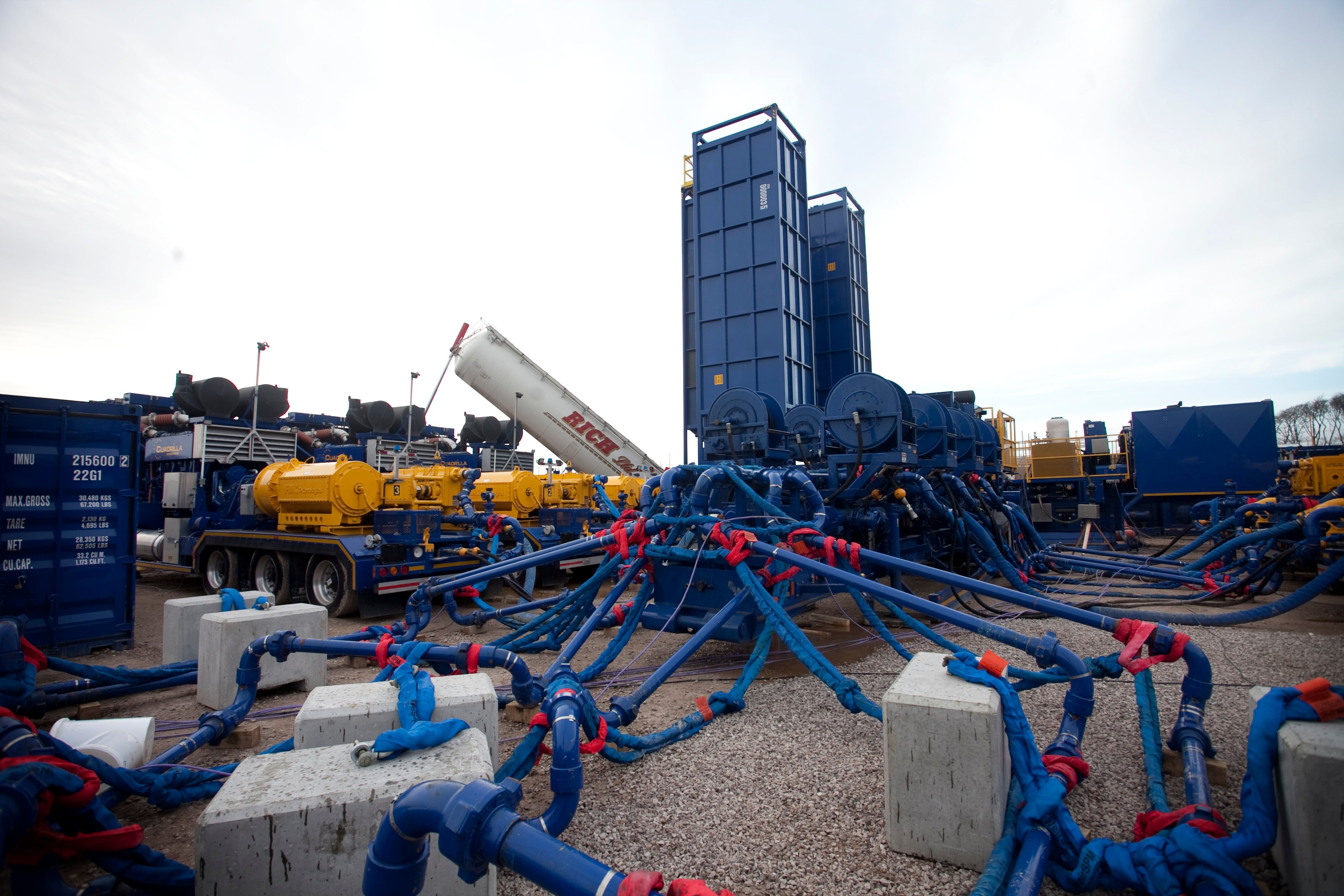 (Click image to enlarge) Hydraulic fracturing equipment in place at Preese Hall. Source: Caudrilla ResourcesThese occurred in 2011 at a place called Preese Hall near Blackpool in northwest England. A subsequent analysis commissioned by the UK's Department of Energy and Climate Change (DECC) concluded that with suitable safeguards – such as the initial injection of smaller amounts of fluid and a threshold of 0.5 on the Richter Scale at which operations would be suspended – there was no reason to suspend fracking.
Cuadrilla has now received approval from the UK's Environment Agency to carry out exploratory drilling and fracking at two other sites close by and, as Quarles says, intends to do so with “effective well monitoring" as a paramount concern. Quarles says that drilling will take place to a depth of 1,000-1,500m, but each of these major boreholes will also be surrounded by a pattern of up to 80 smaller boreholes 100m in depth to create a "microseismic facture mapping array." In addition, as many as eight surface seismic monitors would be buried 1m below ground level. One goal will be to ensure that there will be no possibility of any fractures produced by fracking to reach overlying aquifers containing potable water.
Safeguarding Water Resources
Protecting water resources is an understandable concern in the UK as elsewhere. Ian Davey, senior advisor with the UK Environment Agency, says that approximately 30% of the UK's supply of drinking water originates via such groundwater sources. That proportion increases to as much as 80% in the case of locations in the southeast of the country. Moreover, he says, a lot of correspondence exists between areas with aquifers and those with oil and gas resources. He says that overlap is consistent of about 35% of the UK's surface area.
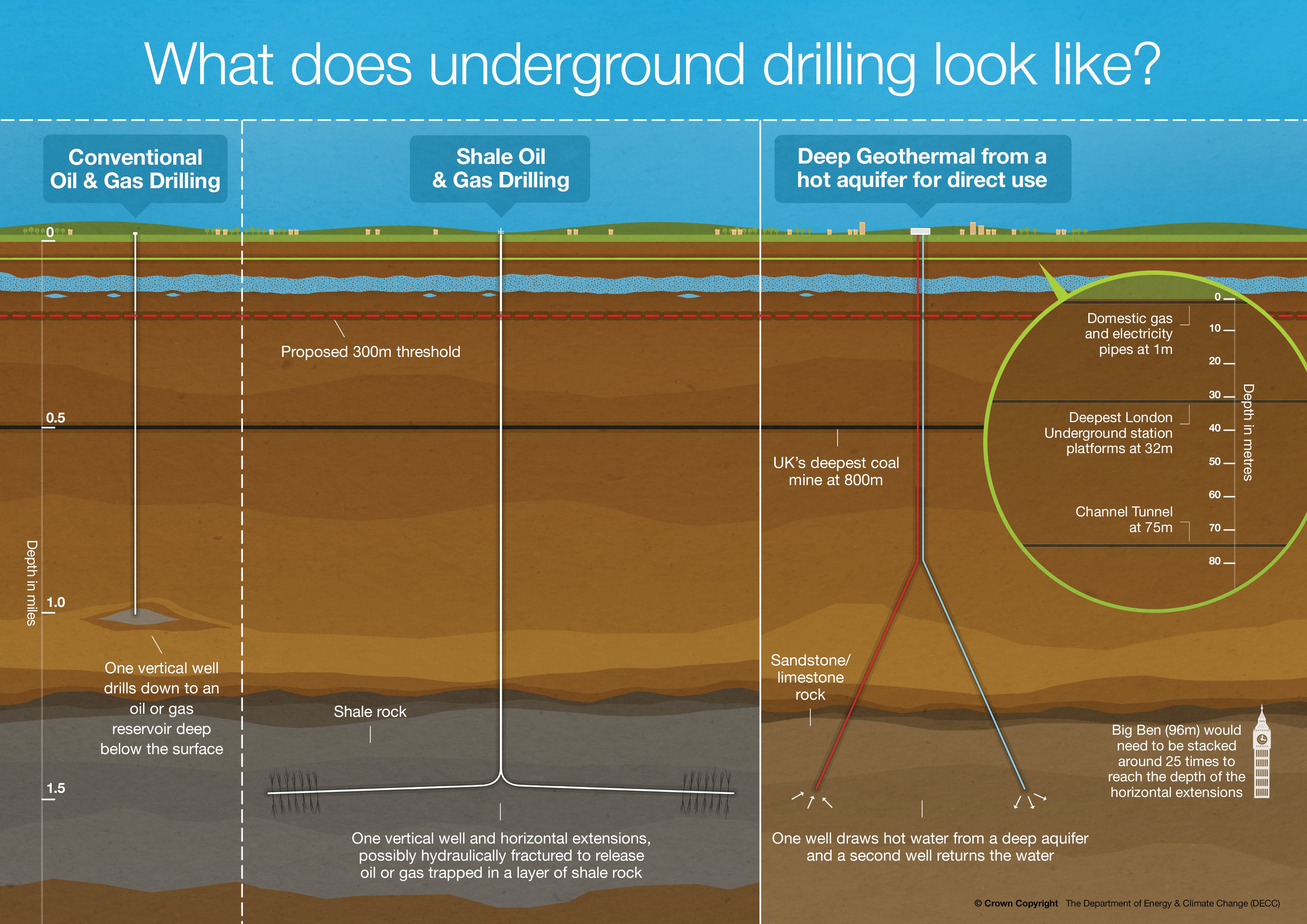 (Click image to enlarge) Fracturing operations are likely to be limited to depths similar to geothermal resource exploitation. Source: UK Department of Energy and Climate ChangeAs a result, adequate protection of drinkable groundwater resources is viewed by many as a precondition of successful exploitation of the UK's shale gas resources. But, as Davey also says, that concern was addressed by the UK Infrastructure Act that was passed into law in February 2015. The Act states that fracking at depths of less than 1,000m will in all cases be illegal in the UK and that specific permission from DECC will be required even for fracking at greater depths. Also fracking in designated "protected groundwater source areas" will not be allowed at all whatever the depth is. The Act, however, offers no definition of what constitutes such an area.
Davey says the limits are not arbitrary and include salient factors about UK geology and known characteristics of the fracking process. For example, UK groundwater resources are generally located well above the 1,000m benchmark. Indeed, the depth of the main part of groundwater bodies in the UK is usually not more than 200m. What's more, research has shown the maximum recorded vertical distance a hydraulic fracture has actually traveled upwards is 588m, although that figure may be exceptional. He says that the chance of a hydraulically induced fracture extending vertically by more than 350m is around 1%.
Nevertheless, Davey also says that there may be occasions when other considerations come into play. Arguably the UK's most famous groundwater source lies beneath the city of Bath where it supplies the country's only thermal spa. This resource has been exploited since the Roman occupation nearly 2,000 years ago. In that case, he says, the water comes up from a depth of 4,000m.
How Much Gas?
How much shale gas actually exists under the land surface of the UK? That question has no definite answer though efforts have begun to make some estimates. In 2013, for instance, another UK government agency, the British Geological Survey (BGS), published a detailed attempt to estimate shale gas resources across Europe. It focused on an area of shale called the Bowland-Hodder formation that stretches across a swath of northern England, roughly the counties of Lancashire and Yorkshire with parts of Cheshire, Derbyshire, Lincolnshire and Nottinghamshire to the south.
The study estimated that this area could contain 822-2282tcf of shale gas, though it is not clear how much would be recoverable in ways that are both economically and environmentally acceptable. The geology of much of the central Scottish Lowlands, Hampshire on the south coast of England, South Wales and the Weald area south of London also make them likely sources of shale gas.
Recovery Economics
So how much might it cost to exploit the UK's shale gas resources?
Cronin says that a study first published by UK employers' organization the Institute of Directors in 2013 (and endorsed in 2014 by consultants Ernst & Young in a further report commissioned by UKOOG projected creating 100 shale gas pads. Each of these would be about two hectares in size – the equivalent of a “couple of football fields" – and support 10 boreholes with four laterals from each vertical shaft. Such a scenario could present a potential high-end output of 1,389bcf (billion cubic feet) of natural gas a year. He says this would cost some £330 million (just under $500 million) per pad to build.
Whether that will happen remains to be seen. But Cronin says the UK shale gas industry is still in it’s “exploration phase" and that it will be a few years before the industry starts to generate real revenues.
Nevertheless, the hydrocarbon industry looks at things in the longer term – a reason why Cronin says he is unphased by the recent drop in oil prices. In the end the potential rewards of an environmentally acceptable exploitation of UK resources may offer a scenario that not only is technically achievable but too great to ignore.