
Nanotech Heats Up Passive Solar Windows
S. Himmelstein | October 24, 2017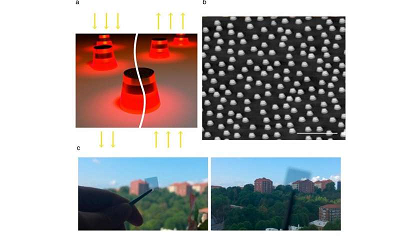 (a) Artistic depiction of a nanoantenna surface. (b) Scanning electron microscope micrograph of the nanoantennas. (c) Photographs of the new surface held against a window. Source: Jonsson et al. ©2017 American Chemical Society
Conventional windows are a major cause of thermal discomfort during cold days as the inner glazing can be several degrees colder than the indoor air. A simple, inexpensive way to convert these windows into solar-powered heat screens was developed by an international team of researchers. The nanotechnology-based solution uses solar energy to increase window temperature by up to 8 K (15° F or 9° C).
The solar thermal surfaces feature nickel-aluminum oxide plasmonic nanoantennas patterned as an array onto glass. Surface plasmons enable the nanoantennas to absorb light and heat the entire surface.
Light is absorbed more efficiently from the front side (with the antennas) than the back side (the substrate). This directionality in light absorption makes the surfaces attractive for window applications, as sunlight can be absorbed most efficiently from the outside of the window. In addition, the surfaces are highly transparent, appear colorless and almost completely preserve the color spectrum of sunlight. Since the material can increase the temperature of the window by several degrees, it has the potential to offer considerable energy savings.
The modular nanoantennas can also be "painted" onto any surface or, to preserve the directionality in absorption, can be directly transferred onto virtually any surface. They can also be manufactured out of a variety of materials, as well as tuned to absorb light of different wavelengths, which changes their color.
The researchers plan to work on achieving even larger temperature increases by enabling the surfaces to absorb ultraviolet and near-infrared radiation, which constitute a significant portion of solar radiation.
Scientists from the University of Gothenburg (Sweden), Linköping University (Sweden), NILT Sweden Filial (Sweden), Chinese Academy of Sciences (China), K. N. Toosi University of Technology (Iran) and Stanford University participated in this development.




Sign me up when this is up and running.