Three American Scientists Earn 2017 Nobel Prize for Physics
Abe Michelen | October 03, 2017
 From left to right: Rainer Weiss, Barry Barish and Kip Thorne. Source: AFP
The Swedish Royal Academy of Sciences awarded the 2017 Nobel Prize in Physics to three
American scientists: Rainer Weiss, an emeritus Professor of Physics at the Massachusetts Institute of
Technology (MIT), and Barry Barish and Kip Thorne, from the California Institute of Technology. The
Academy awarded the prize for their work on the Laser Interferometer Gravitational-Wave Observatory
(LIGO), the gravitational wave detector and—in the words of Göran Hansson—for their "decisive contribution to LIGO's detectors and the observation of gravitational waves—adiscovery that shook the world." Hansson is secretary general of the Swedish Royal Academy of Sciences. Rainer Weiss will receive one-half of the award; the other half will be shared by Thorne and Barish.
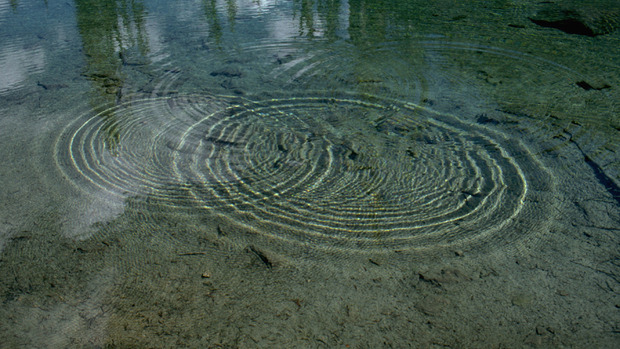 Illustration of gravitational waves. Source: Caltech
Gravitational waves are ripples in the space-time caused moving massive objects. Albert Einstein was the
first to describe the existence of these waves, but was convinced that no one would be able to detect them. In his General Theory of Relativity he predicted that some of the most violent bodies of the universe—including black holes orbiting around each other and neutron stars—release energy in the form of gravitational waves that move (expand) at the speed of light, deforming the space-time like a stone does when falling in a pond. Because these phenomena happen so far away, the generated waves are so weak after reaching Earth that there “will never be a technology capable to capture or detect them,” Einstein said.
 Two-dimensional illustration of how mass in the Universe distorts space-time. Source: NASA
One century after Einstein's prediction, on September 14, 2015, the LIGO detectors captured the first ever gravitational wave, after work that begun five decades earlier. Among other scientists all over the world, the 2017 Laureates were the main researchers in this project. The waves they detected were produced by the collision of two black holes some 1.3 billion years ago.
 Illustration of gravitational waves produced by two orbiting black holes. Source: Henze/NASA
In the 1960’s, Rainer was the first who designed the first laser interferometers for the purpose of detecting these waves.
Years later, Kip Thorne, a theoretical physicist at CalTech began designing similar devices. Both projects eventually gave rise to the LIGO system. Barry Barish, in 1990 led the stage of construction and start-up of the two interferometers of the project, which are more than 1,900 miles apart in order to maximize the chance to detect one signal. Barish was also instrumental in giving the project its international dimension, with more than 1,000 scientists from 20 countries.

“The first gravitational wave was captured 20 years after we built the first version of LIGO," Barish
said in a telephone interview with the Nobel committee, minutes after receiving the call from the committee announcing that he had won.
“Einstein was right in saying that the signals would be extremely small, but he underestimated the advancement of technologies capable of capturing them. The actual size of the signal was about a thousand times smaller than a proton," said Barish.
The signals detected by LIGO and Virgo, the European equivalent of the interferometers, open an extraordinary era in the exploration of the universe. For the first time, the knowledge from observing the universe is not based on the observation of light and particles in all their variants, but on tiny deformations of space-time, the material of which the universe is made, which can reveal the properties of bodies invisible to conventional telescopes.
A Personal Note
On November 11, 2005, Kip Thorne was invited to Rensselaer Polytechnic Institute (RPI), my alma mater, to offer a lecture, as part of the Robert Resnick Lecture Series, titled “Einstein’s General Relativity, from 1905 to 2005: warped Spacetime, Black Holes, and Gravitational Waves.” I had the privilege of spending that afternoon escorting him around campus and having a great conversation. In the lecture hall, full of RPI students and faculty, he recounted that he made a bet with his great friend Stephen Hawking about who would be the first to detect gravitational waves. Hawking accepted the challenge—Thorne said—with the condition that the loser would provide the winner with a one-year subscription to Playboy magazine, causing the lecture hall to erupt with laughter. I wonder now, if he got his subscription. The flyer announcing this lecture, with Kip Thorne’s signature, is shown above.