Magnetic Electrodes Boost Fullerene-Based Solar Cell Efficiency
S. Himmelstein | October 05, 2017Magnetic electrodes have been demonstrated to improve the efficiency of an organic photovoltaic cell by 14%. 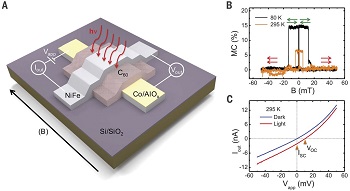 Schematic of the molecular spin-photovoltaic device. (Credit: nanoGUNE)An international team of researchers equipped a solar cell fabricated from fullerene C60 with cobalt and nickel magnetic devices. The combination forms a molecular spin-photovoltaic device molecular spin-photovoltaic device in which control of spin direction enhances efficiency.
According to researcher Luis Hueso from the nanoGUNE Cooperative Research Center in Spain, “The spins of the usual solar cells are ‘disordered’ but thanks to magnetism we have managed to ‘order’ them so that a bigger current can be collected.”
The device can also directly generate alternating current, eliminating the use of transformers required with deployment of direct current-producing solar cells. “The reversal of the current takes place in the device itself when the electrons created by the light interact with the magnetic contacts, whose spins have been ‘ordered’,” explains Hueso.
The researchers plan to optimize photovoltaic system design and performance by exploiting other organic materials which are more efficient than fullerene.
Scientists from the Chinese Academy of Sciences and the Max Planck Institute (Germany) also participated in this research.