
Hydrogen Sensor is Ultra-Fast and Super-Sensitive
S. Himmelstein | October 02, 2017An ultra-fast, ultra-sensitive hydrogen sensor can detect hundreds of parts per million levels of the gas within 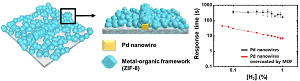 Pd nanowires are covered by a metal-organic framework layer. Source: KAIST/University of California-Irvine60 seconds at room temperature. Researchers from the Korea Advanced Institute of Science and Technology (KAIST) and the University of California-Irvine developed the device with a palladium nanowire array coated with a metal-organic framework that can detect hydrogen.
The researchers coated lithographically patterned Pd nanowires with a zinc-based zeolite imidazole framework (ZIF-8) layer composed of Zn ions and organic ligands. ZIF-8 film is easily applied to Pd nanowires by dipping in a methanol solution, including zinc nitrate hexahydrate and 2-methylimidazole.
Thus, the ZIF-8 filter on the nanowires allows the predominant penetration of hydrogen molecules while screening out larger molecules. The method results in Pd-based sensors with a 20-fold faster recovery and response speed compared to non-coated Pd nanowires at room temperature.
As the device detects hydrogen gas levels under 1 vol% in less than seven seconds, it should be useful in preventing explosions caused by hydrogen gas leaks.



I wonder what the detection span of %H2 in the gas stream to the sensor is? Can it detect high percentages as well as low ones?