Novel Technique for Low-Cost Nanowire Production
Ed Brown | January 24, 2017Georgia Tech researchers have developed a technique for producing oxide nanowires directly from bulk materials.
The method works at ambient temperature and pressure without the use of catalysts, toxic chemicals or processes such as chemical vapor deposition.
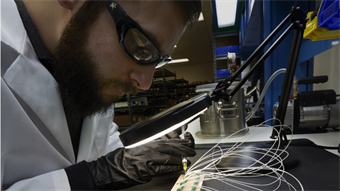
 Crucible in which an alloy of lithium and aluminum is formed."You can essentially put the bulk materials into a bucket, fill it with a suitable solvent and collect nanowires after a few hours, which is way simpler then how many of these structures are produced today," says Gleb Yushin, a professor in the School of Materials Science and Engineering at the Georgia Institute of Technology.
Fabrication of the nanowires begins with the formation of alloys composed of one reactive and one non-reactive metal, such as lithium and aluminum. The alloy is then placed in a solvent, which could include a range of alcohols, such as ethanol. The lithium dissolves from the surface into the solvent, initially producing nuclei (nanoparticles) comprising aluminum.
The continuous dissolution of lithium allows gradual formation of aluminum alkoxide nanowires, which grow perpendicular to the surface of the particles. The alkoxide nanowires can then be heated in open air to form aluminum oxide nanowires, which can be formed into paper-like sheets. The process generates hydrogen gas, which could be captured and used to help fuel the heating step and the lithium can also be recovered and reused.
The diameters of the nanowire structures can be controlled from tens of nanometers up to microns by varying the solvent and the processing conditions.
One important application may be separator membranes for lithium-ion batteries. The polymer separation membranes typically used in these batteries cannot withstand the high temperatures generated by certain failure scenarios.
As a result, commercial batteries may induce fires and explosions if not designed very carefully. Using low-cost paper-like membranes made of ceramic nanowires could help address those concerns because the structures are strong and thermally stable, while also being flexible.