
Video: Cleaner rocket fuel makes use of MOFs
S. Himmelstein | April 11, 2019Hypergolic fuels currently used as rocket and spacecraft propellants ignite upon contact with an external oxidizer. These fuels contain hydrazine, a highly toxic and dangerously unstable chemical compound. To help prevent the atmospheric release of 12,000 tons/year of hydrazine fuels, an international research team developed an alternative and more eco-friendly fuel based on metal organic framework (MOF) materials.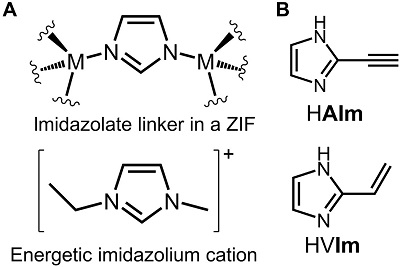 (A) Similarity between the organic linker in a ZIF (top) and a typical energetic imidazolium cation (bottom). (B) The ligands acetylene (HAIm) and vinyl (HVIm) used in the development of hypergolic ZIFs. Source: H. M. Titi et al.
A process for inducing the requisite hypergolic behavior in MOFs was engineered through the use of an acetylene or vinyl substituent as a trigger in a zeolitic imidazolate framework (ZIF). Six ZIFs based on zinc, cobalt and cadmium cations were fabricated and tested with acetylene and vinyl to activate the latent energetic properties of electron-deficient linkers in the MOFs. The desired hypergolic properties, including short ignition delays, were observed in the resulting fuel.
The triggers and synthesis technology described in Science Advances effectively induced hypergolocity without affecting the overall energetic content of the ZIF structures. The researchers from 525 Solutions (Alabama), McGill University (Canada) and University of Birmingham (U.K.) will next examine the use of other transition metals as nodes to accelerate the development of new MOF hypergols and improve the performamce of these environmentally friendly propellants.




Cadmium?
In reply to #1
Yes, cadmium is highly toxic and should not be used as an example of a component of a "greener" fuel. But it was used in the study to investigate on a fundamental level what factors (i.e. type of metal) lead to enhanced hypergolic properties of the MOF.