Activated Carbon Injection Led Mercury Compliance Tech, EIA Says
David Wagman | September 18, 2017Several coal-fired electricity generators in the United States installed mercury control equipment using activated carbon injection systems in advance of compliance deadlines.
The Energy Department's Energy Information Administration (EIA) says the nature and timing of control additions indicate a strategy to maintain the availability of affected coal-fired generators by requesting extensions to compliance deadlines and investing in flexible, low-cost environmental control technology.
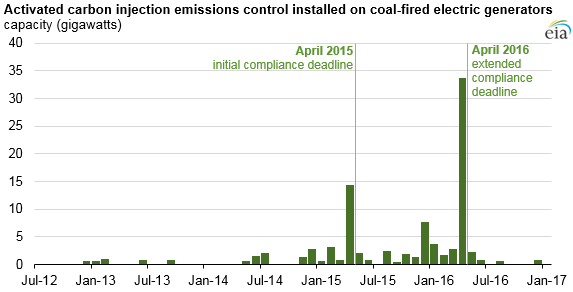 MATS compliance timing. Credit: EIAAt the end of 2011, the U.S. Environmental Protection Agency (EPA) announced standards to limit mercury, acid gases and other emissions from power plants. EPA’s final ruling, called the Mercury and Air Toxics Standards (MATS), was released in February 2012. MATS required all coal- and oil-fired generators that sell power and have a capacity greater than 25 megawatts (MW) to comply with emissions limits for toxic air pollutants associated with fuel combustion such as mercury, arsenic and heavy metals. At the time, the rule applied to around three-quarters of all operating coal units, which represented 99 percent of generating capacity. The initial compliance deadline was April 16, 2015.
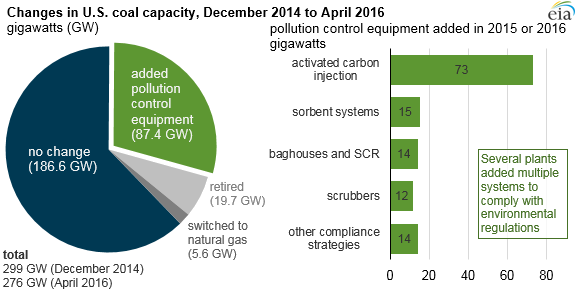 Activated carbon injection has been a leading control technology. Credit: EIABetween January 2015 and April 2016, about 87 GW of coal-fired plants installed pollution-control equipment, and nearly 20 GW of coal capacity retired, EIA says. About 26 percent of those retirements occurred in April 2015, meeting the MATS rule's initial compliance date. Some 142 GW of coal plants had applied for and received one-year extensions that allowed them to operate until April 2016 while finalizing compliance strategies.
An additional one-year extension to April 2017 was granted to a few units critical to ensuring electric reliability, EIA says. Five coal plants with a combined capacity 2.3 GW received this extension. Since then, two of the five plants have retired: one converted to natural gas, and one installed MATS-compliant controls. The remaining plant, Oklahoma’s Grand River Energy Center, was granted another emergency extension for reliability issues in April.
EIA says that of the coal capacity installing pollution control equipment to comply with MATS, activated carbon injection (ACI) was the dominant compliance strategy, with close to 78 GW of coal capacity adding ACI.
Activated carbon injection systems work by injecting powdered activated carbon into the flue stack (exhaust) of a coal-fired power plant. This powered activated carbon then absorbs the vaporized mercury from the flue gas and is collected from the plant's particulate collection device. Activated carbon is a carbonaceous, highly porous adsorptive medium that has a structure composed primarily of carbon atoms.
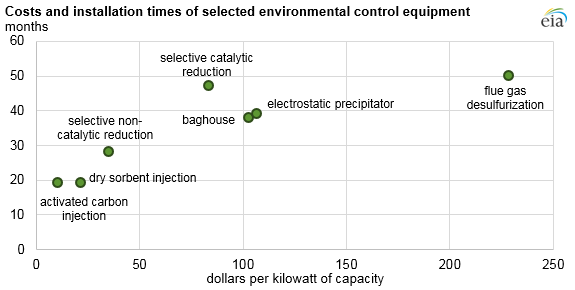 Compared against other technologies, ACI can be installed quickly and relatively inexpensively. Credit: EIAACI technologies have the shortest construction lead time of the compliance control technologies—between 12 and 18 months— and the lowest installation cost—about $11 per kilowatt (kW), EIA says. Other technologies, such as electrostatic precipitators (ESP) and baghouses have longer lead times and higher costs. Flue gas desulfurization (FGD) has the highest average lead time, at 50 months, and the highest installation cost, at $228/kW.
Environmental control technologies vary in terms of which air pollutants they remove. For example, FGD technologies can control mercury, sulfur dioxide and acid gases, whereas ESPs can control mercury, non-mercury metals and acid gases.