This technique is keeping coal in the power generation mix
David Wagman | February 08, 2019Coal-fired power plants may be closing across the U.S., but those that remain are burning more specially processed coal to reduce their air emissions.
According to the Energy Department's Energy Information Administration (EIA), consumption of so-called refined coal reached record highs in 2017, and was on track to grow even more in 2018.
 Refined coal's use has grown despite a general decline in total U.S. coal consumption that began with the economic recession in 2008.
EIA said that for the first three quarters of 2018, refined coal production totaled 121 million short tons (MMst). That equaled about 21% of total U.S. coal production. Refined coal generated more than 235 million megawatt-hours (MWh) of U.S. electricity in 2017, or 20% of net coal generation. EIA estimates of refined coal through October 2018 suggested an even larger increase in refined coal use to more than 22% of total coal generation.
Refined coal is typically made by mixing one or more additives to feedstock coal. These additives most often contain a mixture of halogens such as bromine or chlorine and metals to increase the production of mercury oxides. Oxidized mercury can be captured by using technologies such as flue gas desulfurization scrubbers. Oxidized mercury can also be adsorbed by powder-activated carbon injection and captured by particulate matter control systems.
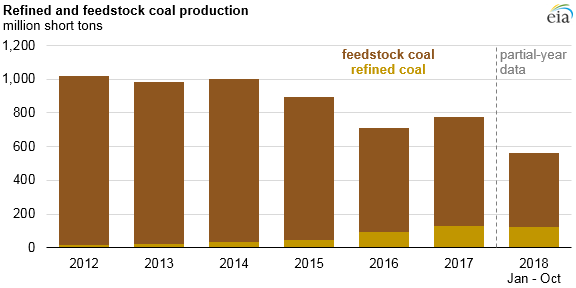 Source: EIAEIA said that refined coal production qualifies for a tax credit under the American Jobs Creation Act of 2004. To qualify for the refined coal tax credit, producers must have a qualified professional engineer demonstrate that burning the refined coal results in a 20% emissions reduction of nitrogen oxide and a 40% emissions reduction of either sulfur dioxide or mercury compared with the emissions that would result from burning feedstock coal.
The tax credit was designed to increase with inflation and was valued at $6.91 per short ton produced in 2017 and $7.10 per short ton in 2018. EIA said that power companies continued to add refined-coal burning plants even as older conventional coal plants retire, with an additional 36 coal plants switching to refined coal products between 2016 and October 2018.