Reconstructing the Life of the Dodo
S. Himmelstein | August 26, 2017What do we really know about the dodo?
The flightless bird was endemic to the island of Mauritius in the Indian Ocean, and was wiped out within 100 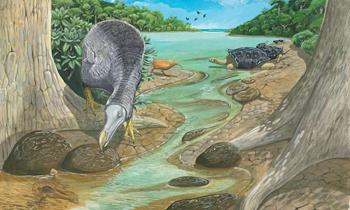 Reconstruction of the dodo in the Mare aux Songes swamp in Mauritius, where a large number of dodo specimens have been found. Source: Julian Humeyears after European colonization. The last widely accepted sighting of a dodo was in 1662.
No complete specimens exist, but analysis of bone histology can shed some light on the life history and ecology of the dodo. Researchers from the Natural History Museum in London and the University of Cape Town, South Africa, studied the structure and composition of 22 bones loaned from museums in France and Mauritius.
Some of the dodos sampled were juveniles. Their bones were unusually rich in fibrolamellar bone, which contains many immature bone cells that can be rapidly deposited, allowing the bird to grow quickly. Other samples had large cavities that corresponded with the molting cycle.
The dodo is theorized to have bred around August. The rapid growth of the chicks enabled them to reach a robust size before the austral summer or cyclone season. Histological evidence of molting suggests that after summer had passed, molt began in the adults that had just bred. The timing of molt indicated by bone histology is also corroborated by historical descriptions of the dodo by mariners.
And now we know that the bird likely weighed 10-14 kilos (22-30 pounds), suggesting a rather large flightless pigeon.