An Eruptive Source of Energy-Critical Lithium
S. Himmelstein | August 17, 2017Much of the lithium used to manufacture Li-ion batteries in the United States is imported. Diversifying the supply chain with domestic lithium resources may be as simple as looking down: Stanford University researchers have identified lake sediments preserved within the calderas of supervolcanoes as important targets for lithium exploration.
These volcanoes can produce massive eruptions of hundreds to thousands of cubic kilometers of magma, and appear as huge holes in the ground, or calderas. Such structures can eventually fill with water to form lakes, and lithium leached from volcanic deposits accumulates in lake sediments.
The researchers analyzed tiny bits of magma trapped in crystals during growth within the magma chamber. These melt inclusions record the original concentrations of lithium and other elements in magma. Sectioning of the crystals exposed 10-100 micron diameter magma blebs, which were analyzed with the Sensitive High Resolution Ion Microprobe in the SHRIMP-RG Laboratory at Stanford Earth.
Samples were collected from the Kings Valley deposit in the McDermitt volcanic field located on the Nevada-Oregon border, which erupted 16.5 to 15.5 million years ago and is known to be rich in lithium. Results from this volcanic center were compared with samples from the High Rock caldera complex in Nevada, Sierra la Primavera in Mexico, Pantelleria in the Strait of Sicily, Yellowstone in Wyoming and Hideaway Park in Colorado. The assessment revealed that lithium concentrations varied widely as a function of the tectonic setting of the supervolcano.
The correlation of other trace elements with lithium concentrations was also evaluated. A previously unknown correlation was discovered that will now enable geologists to identify candidate supervolcanoes for lithium deposits in a much easier way than measuring lithium directly in melt inclusions. A greater abundance of easily analyzed rubidium in the bulk deposits indicates more lithium, whereas high concentrations of zirconium indicate less.
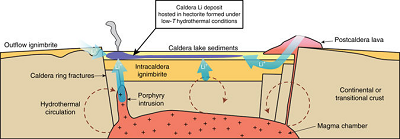 Schematic model for the formation of caldera-hosted Li clay deposits. Li is leached from ignimbrite and caldera-related lavas by meteoric and hydrothermal fluids and is deposited in hectorite clays formed within ash-rich caldera lake sediments. (Source: Stanford University)