Polystyrene Particles Support Perovskite Solar Cell Stability
S. Himmelstein | August 15, 2017The use of polystyrene particles instead of pricey polymers is expected to improve the stability and reduce the manufacturing cost of solar cells.
Widespread diffusion of solar panels in the UK is still hampered by high production costs of traditional silicon-based photovoltaics. Recent research has turned to the use of cheaper perovskite as the light harvesting layer instead of silicon. The power conversion efficiency of perovskite solar cells is approaching parity with established photovoltaic technology.
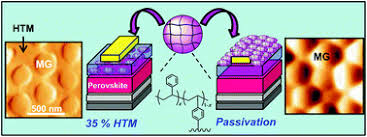 Perovskite solar cell stability is improved by use of composite HTM-microgel. (Source: University of Manchester)The current use of organometallic halide perovskite as a light absorber poses a limitation, as the material readily degrades when exposed to water. These perovskite cells also rely on a hole-transportation layer, which promotes the efficient movement of electrical current after exposure to sunlight. But manufacturing the hole-transportation organic materials is very costly and these lack long-term stability.
University of Manchester, UK, researchers see the use of insulating polystyrene microgel particles as a remedy. These materials are being tested to reduce the costs and improve the stability of perovskite solar cells (PSCs).
Explains Prof. Brian Saunders, Professor of Polymer and Colloid Chemistry from the School of Materials at The University of Manchester, “The perovskite layer in solar cells is not inherently unstable, but the required HTM (hole-transport material) layer is. HTM layers made of congregated polymers are thin but they are also relatively expensive and contribute a significant portion of the total cost of the solar cell. In this study we used polystyrene, which is 1 ten thousandth of the cost of polymers to produce, and is also hydrophobic which helps improve the stability of PSCs. Overall the enhanced stability and lower costs of production hugely outweigh any of the decreased efficiency.”
Solar cell stability data documented for PSCs containing composite HTM-microgel were superior compared to data measured for a control PSC.