
Nanocoating Spray to Extend Produce Shelf Life
Tony Pallone | August 11, 2017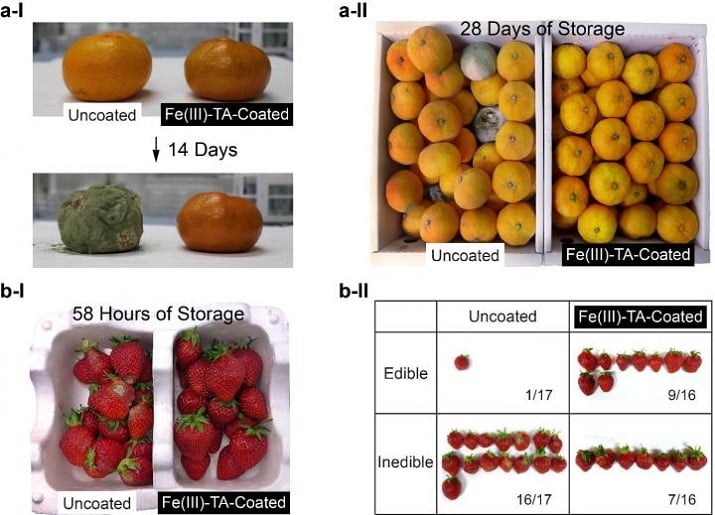 Uncoated versus coated fruits, plus statistical investigation of resulting edibility. Source: KAIST.
A team of researchers at the Korea Advanced Institute of Science and Technology (KAIST) has developed a sprayable nanocoating technique for extending the shelf life of produce.
The technique relies on nanometer-thick films made with plant-derived polyphenol, and can be applied to any surface in a matter of seconds. Past techniques have depended upon highly specific interactions between coating materials and target surfaces for a stable and durable coating. Because they depend on dipping substrates into specialized coating solutions, they have also proved to be time-consuming or impractical for the coating of bulk substrates such as fruits. Avoiding cross-contamination is another challenge for traditional immersion methods.
Polyphenols are a metabolite of photosynthesis with excellent antioxidant properties, and are known to exhibit antibacterial and potentially anti-carcinogenic capabilities. They have been widely used as a nontoxic food additive. By adding iron ions to polyphenols, the researchers created an adhesive complex that could be sprayed onto a variety of materials. When used on produce, the spray was shown to significantly improve the post-harvest shelf life of strawberries (to 58 hours) and tangerines (to 28 days). Uncoated fruit used as a benchmark decomposed and became moldy under the same conditions.
The researchers also demonstrated the spray’s ability to coat textile fabrics, metals, plastics and glass. It can be used to form antifogging films on corrective lenses, as well as antifungal treatments for shoe soles.
Research team leader Insung Choi, a chemistry professor at KAIST, noted that "nanocoating technologies are still in their infancy, but they have untapped potential for exciting applications. As we have shown, nanocoatings can be easily adapted for several different uses, and the creative combination of existing nanomaterials and coating methods can synergize to unlock this potential."
The research results have recently been published. The technology has been patented, and is currently being commercialized for widespread use on produce.



This might create a new market for those folks that sell organically grown fruits and vegetables. Now with all of the other myrid of anti this and anti that symbols, as well as the pro symbols etc , we will soon see something like NNC, or non-nano coated.