
A Geoengineering Technique Called Cloud Brightening Could Slow Global Warming
Siobhan Treacy | July 26, 2017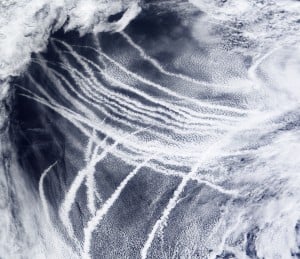 Ships crossing the Pacific Ocean emit particles into the clean air that create a seed for marine clouds. Image credit: NASA
A new University of Washington study focuses on the idea of marine cloud brightening, which is being investigated by a UW group as a strategy to offset global warming. The strategy is to spray saltwater into the air to make marine clouds reflect more incoming solar rays. Small-scale tests of marine cloud brightening could help answer many scientific questions about clouds and aerosols. The goal for these geoengineering tests would follow the 2015 recommendations from the U.S. National Academies of Sciences that said any tests of geoengineering also yield scientific benefits.
"A major, unsolved question in climate science is: How much do aerosol particles cool the planet?," said lead author Rob Wood, a UW professor of atmospheric sciences. "A controlled test would measure the extent to which we are able to alter clouds, and test an important component of climate models."
The authors of this paper are part of a group that is proposing to spray salt water over oceans in order to cause a small increase in the brightness of marine clouds and boost the capacity to reflect sunlight. Doing this could be a short-term measure to offset global warming in a possible future emergency situation. It could further the understanding of our climate system.
The biggest problem in climate models is the clouds, which can reflect sunlight in unpredictable ways. Water droplets can only condense on airborne particles like smoke, salt or human pollution. When the air contains more particles, the same amount of moisture can form smaller droplets. This creates whiter, brighter and more reflective clouds. Climate scientists believe pollution since the Industrial Revolution has created brighter clouds that reflect more sunlight. This is offsetting the warming from greenhouse gases and traps long-wave radiation. They can’t pin down the size of the effect or predict how much it may change in the future.
"Testing out marine cloud brightening would actually have some major benefits for addressing both questions," Wood said. "Can we perturb the clouds in this way, and are the climate models correctly representing the relationship between clouds and aerosols?"
The proposal is waiting on funding to go further with this research. For years, UW researchers have been working with a group of engineers to develop a nozzle that will turn saltwater into tiny particles that could be sprayed high enough to reach the marine cloud layer. This is the first of many steps needed to implement the team’s three-year plan.
The researchers are proposing to produce a sprayer that can eject trillions of aerosol particles per second and conduct lab tests of the sprayer. They also want to do preliminary outdoor tests in a coastal area that is flat, free of air pollution and prone to marine clouds. Finally, they want to move small-scale offshore tests, if the original tests were successful. People may someday decide whether to use a scaled-up version to create a small increase in reflection of sunlight over the oceans.
Along with the paper on the scientific benefits of cloud brightening, the team of UW graduate students and professors has published a paper on what specific measures would need to be taken for successful cloud brightening test evaluation.
To learn more about this paper and research, click here.



Why not test it in an area where coral reef is endangered from temperature related bleaching events? The GBR is the candidate with my vote..
If the idea has legs it will find them through protection of reef environment.
If it's not capable.. Give up.
In reply to #1
I know it is popular to blame everything bad on a temperature increase, but bleaching of coral reefs seems like a big stretch.
The years that widespread bleaching has occurred don't align with the years with peak temperatures either in air or surface waters. There is also the coral in the red sea which is at far higher temps and not bleached.
Most large established reefs are 5000 to 10000 years old. Many estimates of sea water temps over the past 10000 years indicate periods with higher temps than the bleaching years.
This has to be due to something else. Run off of some type would be my guess.
Here are some temperature measurements over the last 100 years not far from the barrier reefs....
Here is one for waters of interest...
In reply to #2
I can fully understand where you're coming from.. In fact I totally agree!?
I've recently watched 'Chasing Coral' on Netflix.
I'd recommend it.
There is a fair amount of information as well as disinformation I'm sure..
What surprised me was the cyclical nature of the bleaching events.
That and how quickly the effected areas would change from live to dead.
Of course the show was heavy on the gloom pedal. It didn't focus on recovery or point at new growth..
My post was an attempt to point this seemingly absurd technology at an area where they are currently bitching about small water temperature fluctuations.
I was watching a show where divers were in icy Alaskan waters that were filled with vibrantl
I'd say more but I have to go for now.
Global warming oops climate change is a hoax propagated by the people making money from it.
Professor Dr. Friedrich Karl Ewert is a retired geologist and data computation expert. He has painstakingly examined and tabulated all NASA GISS’s temperature data series, taken from 1153 stations and going back to 1881. His conclusion: that if you look at the raw data, as opposed to NASA’s revisions, you’ll find that since 1940 the planet has been cooling, not warming.
From the publicly available data, Ewert made an unbelievable discovery: Between the years 2010 and 2012 the data measured since 1881 were altered so that they showed a significant warming, especially after 1950. […] A comparison of the data from 2010 with the data of 2012 shows that NASA-GISS had altered its own datasets so that especially after WWII a clear warming appears – although it never existed.
But the activist scientists at NASA GISS – initially led by James Hansen , later by Gavin Schmidt – wanted the records they are in charge of maintaining to show warming not cooling, so they began systematically adjusting the data for various spurious reasons using ten different methods.