Stacked Cell Design Taps Full Solar Spectrum
S. Himmelstein | July 13, 2017A new multijunction solar cell developed on a gallium antimonide substrate harnesses the long-wavelength photons typically lost in conventional multijunction cell designs. George Washington University researchers used concentrator photovoltaic panels that employ lenses to concentrate sunlight onto tiny, micro-scale solar cells. The stacked cell converts direct sunlight to electricity with 44.5 percent efficiency.
Unlike conventional materials for high-efficiency multi-junction solar cells, the GaSb-based cells harvest 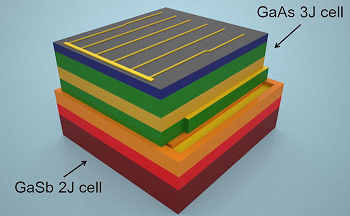 Image credit: George Washington Universitywavelengths in the 250 nm-2,500 nm spectral range. The increase in conversion efficiency is achieved by assembling the new devices into a stacked structure along with high-efficiency solar cells grown on conventional substrates that capture shorter wavelength solar photons. The use of transfer-printing in the stacking process enables 3-D assembly of the tiny devices with a high degree of precision.
Despite the high costs of the materials involved, the researchers wanted to demonstrate the upper limit of what is possible in terms of efficiency. A similar product may eventually be brought to market, enabled by cost reductions from very high solar concentration levels and technology to recycle the expensive growth substrates.