
Water Purification in a Sack
Abe Michelen | June 27, 2017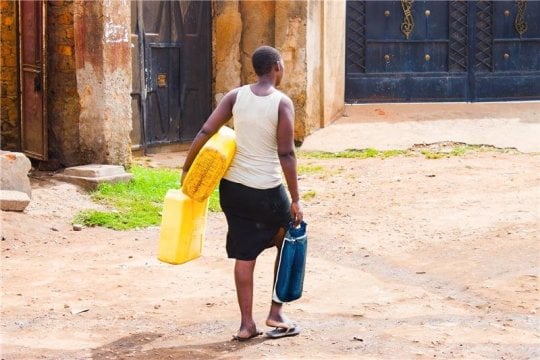 SolarSack in use in Uganda. (Source: Aalborg University)Two architecture students at the Aalborg University in Denmark have created an inexpensive and friendly new water purification system they call “SolarSack.” The system has been tested with great success in villages, slums and refugee camps in East Africa. The "device" is essentially a special bag that is filled with four liters of water and placed in the sun for four hours, after which the water will be pasteurized and ready to drink.
The pasteurization process is accomplished by UVA and UVB rays, as well as by the heat from the sun. The sack can be reused about 150 times, so one bag can provide 600 liters of water. The sack was tested and approved by the World Health Organization (WHO), finding that between 99.9 and 99.999 percent of the pathogenic bacteria in the water dies.
"We estimate that a SolarSack can be produced for less than one and a half Danish kroner, transported and end up in the hands of the user for less than a dollar. The bag can be reused 150 times, making it significantly cheaper than the alternatives," says Louise Ullmann, AAU.
Costing less than one dollar to produce 600 liters of pure water, including distribution, this represents one-fifth the cost of a bucket of coal. A bucket of coal provides less than 100 liters of purified water when used to heat the water to kill bacteria. Also, calculating shipping and distribution still gives SolarSack one-twentieth the CO2 emissions compared to boiling with coal, while totally eliminating the use of wood.
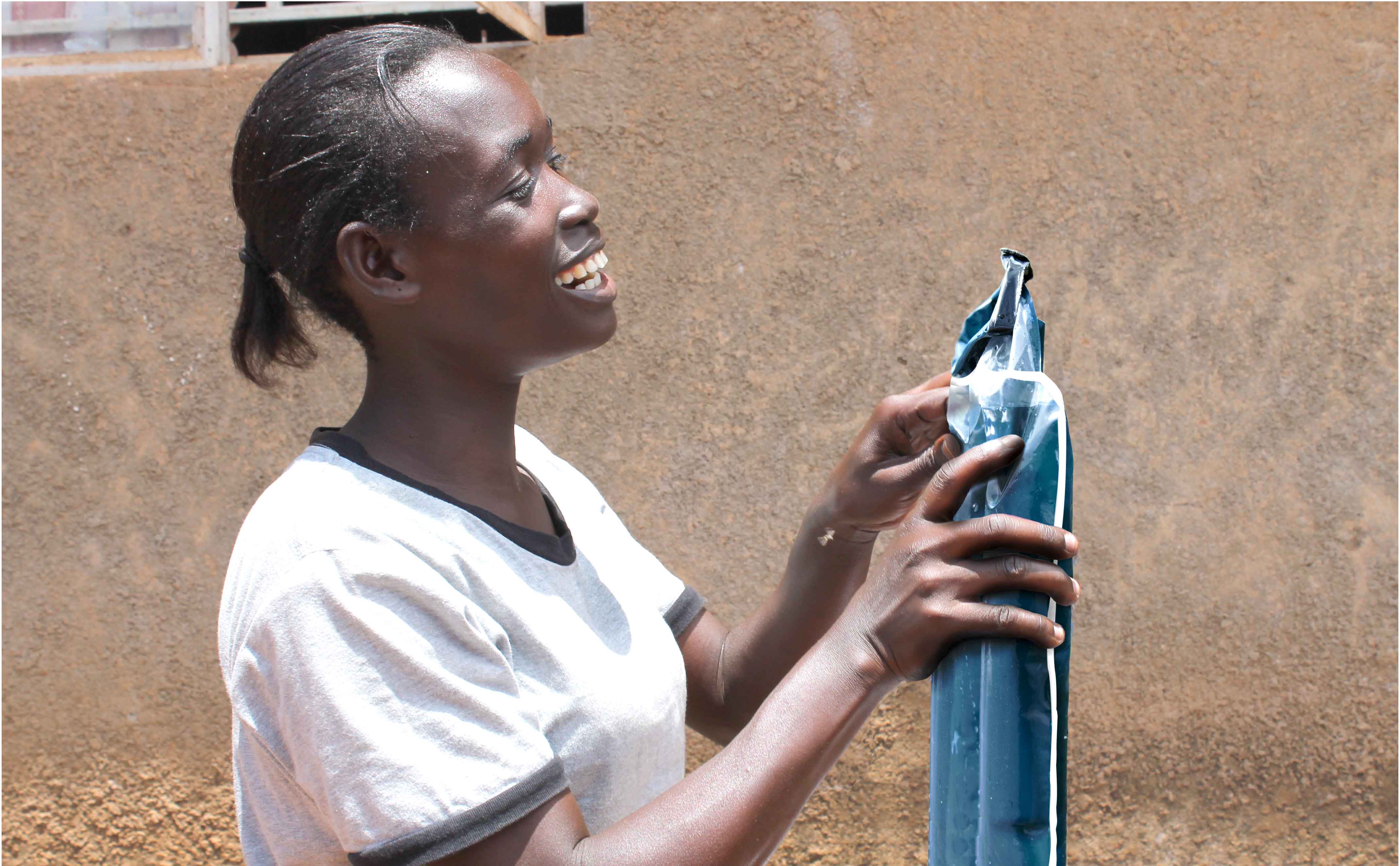 A Ugandan woman is happy with the SolarSack. (Source: Aalborg University)Anders Løcke and Louise Ullmann, the creators of SolarSack, certainly have made an enormous social contribution to the well-being of people. According to the WHO, more than 45 million people, in East Africa alone, lack access to clean drinking water, even while poor water and sanitation conditions remain the main cause of more than 80 percent of diseases in the region. Boiling water, the most widely used method, is both expensive and not environmentally friendly. To find a solution, Anders and Louise went to Uganda to study the problem in detail.
"After the first study in Uganda, it became clear that the use of coal and wood constitutes a major threat to the natural environment, and the price of fuel increases as forests are cleared. So we decided to use sunlight as a resource for water purification. There is plenty of sunlight in Africa, and it's free," says Anders Løcke.
The two students just graduated from Aalborg University and created a company to produce and distribute the invention. The Red Cross has offered to collaborate with this new company. "Red Cross Kenya is valuable as both a sparring partner now and later as a customer, so we're really pleased that they're interested in collaboration. As an established NGO, they have the ability to get SolarSack out to all corners of the country that need water purification," says Anders Løcke, AAU and SolarSack.
These types of stories not only make East African people happy, but it should also make all of us happy and proud.


It is good to know that solar pasteurisation got the recognition of world bodies, which may be a great lifesaver for the people of the Third World.
We started work on Solar Pasteurisation devices as early as 1982 and had a few publications [1-5]. We focused on devices that people in rural areas in the Third World can make at home using available materials, so that they do not have to depend on supplies. We carried out extensive microbiological studies which confirmed destruction of diarrhoeal germs. Some communities used it in Bangladesh during problem times. We also have a design of a portable manufactured device which we called a 'LifeRoll' that can be rolled into a small package for delivering in disaster areas or easy carrying in a backpack (it is yet to get funding for manufacture).
1. Rabbani K S, Elimination of diarrhoeal pathogens from drinking water using low cost solar devices, Proceedings of the International Conference on Physics and Energy for Development, Dhaka, p.317(1985).
2. Rabbani K S, Provision of drinking water in third world villages - Alternative techniques using renewable energy sources., Proceedings, Second World Renewable Energy Congress, Reading, UK, p.774-778, (13 - 18 September, 1992)
3. Rabbani K S, Low cost solar thermal devices to provide arsenic and germ free drinking water for rural areas, Proceedings of the International Conference on Renewable Energy for Rural Development, BUET, Dhaka, p. 285-291 (19-21 January, 2002)
4. Rabbani K S, Looking for safe drinking water? - Techniques using free sunshine and rain – a publication of the Department of Biomedical Physics & Technology University of Dhaka, Bangladesh, 2011. Can be viewed at: http://bmpt.du.ac.bd
5. Rabbani K S, Low cost domestic scale technologies for safe drinking water, 7th International Conference on Appropriate Healthcare Technologies for Developing Countries, 2012. DOI: 10.1049/cp.2012.1465