
UK Report: Measurement Challenges in the Hydrogen Industry
S. Himmelstein | June 13, 2017A new report from the National Physical Laboratory (Middlesex, UK) highlights and prioritizes the current measurement challenges facing the hydrogen industry.
Hydrogen in the UK is beginning to shift from hypothetical debates to practical demonstration projects. However, the fuel and energy carrier has yet to have wide commercial uptake, due in part to a number of barriers where measurement plays a critical role. To accelerate the shift toward the hydrogen economy, these challenges have been identified.
Six challenges are outlined as high priority in Energy transition: Measurement needs within the hydrogen industry:
Material development for fuel cells and electrolysers, to reduce costs and assess critical degradation mechanisms – extending lifetime and durability is key to the commercialization of these technologies.
- Impact assessment of added odorant to hydrogen to aid leak detection. Measurement of its impact during pipeline transportation and on the end-use application (particularly fuel cell technology) will be important to provide assurance that it will not affect lifetime and durability.
- Determination of the blend ratio when hydrogen is mixed with natural gas in the gas grid. Accurate flow rate measurement and validated metering methods are needed to ensure accurate billing of the consumer.
- Measurement of the combustion properties of hydrogen, including flame detection and propagation, temperature and nitrogen oxides (NOx) emissions, should it be used for heat applications, to ensure existing and new appliances are suitable for hydrogen.
- Assessment of the suitability of existing gas infrastructure and materials for hydrogen transportation. Building an understanding of what adaptations might need to be made to avoid for example air permeation, metal embrittlement and hydrogen leakage.
- Validated techniques for hydrogen storage, which will require measurement of the efficiency and capacity of each mechanism, through robust metering, leakage detection and purity analysis to ensure they are optimized for the storage of hydrogen gas.
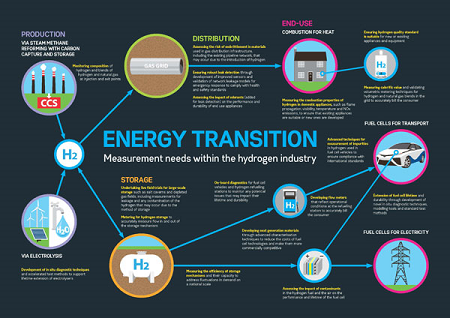 (Source: National Physical Laboratory)



Whats wrong with natural gas again?
Hydrogen is all good until it goes Kabooom! And it will!