How the Solar Spectrum Can Satisfy a “Full Earth”
S. Himmelstein | June 10, 2017A new concept espoused by Purdue University (West Lafayette, IN) researchers seeks to combine systems that simultaneously use different parts of sunlight’s spectrum to produce crops, generate electricity, collect heat, and purify water. In this manner, food, energy, and water resources can be provided for the growing world population, projected to reach 10 billion over the next two to three generations and leading to a “full earth” scenario.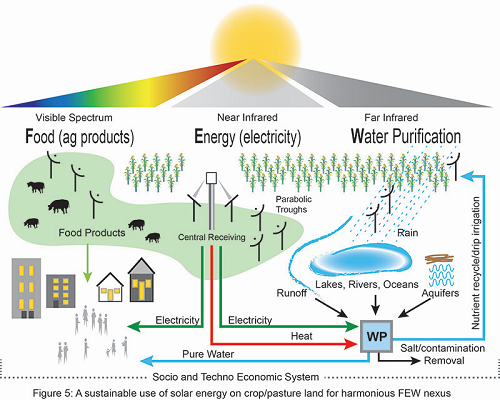 A proposal to simultaneously use different parts of sunlight’s spectrum to produce crops, generate electricity, collect heat and purify water on the same piece of land could provide resources in a “full-earth” scenario. (Purdue University image/Rakesh Agrawal, Pamela Burroff-Murr)
Currently much of the solar spectrum is wasted because all of the sunlight falling on a given spot is used solely for one purpose, such as agriculture, energy production, or water purification. The proposed approach would instead use the same land mass for all three purposes simultaneously through innovative technologies that split the spectrum into three segments and efficiently harvest sunlight.
A typical photovoltaic panel, when installed on farmland, casts a shadow and dramatically reduces plant growth and crop yield from the shadowed area. Envisioned photovoltaic designs transmit photons responsible for plant growth while reflecting remaining photons in the solar spectrum to specially-designed solar cells to generate electricity and collect heat for energy recovery and water purification.
Solar spectrum splitting to maximize electric power generation and heat recovery is well known.
“However, its feasibility in the context of food, energy and water resources on the same land has never been reported,” states Muhammad Ashraful Alam, Professor of Electrical and Computer Engineering. “Here, we not only consider this possibility and develop systems to achieve this goal, but also through modeling show the vast unexplored potential of such a system toward meeting the food, energy and water needs for a full earth.”
The researchers say the proposed system could create solar-powered, self-sufficient communities -- a major step toward full-earth preparedness.
Water from sources such as underground wells, oceans, rivers, lakes, ponds, and field runoff would enter water purification units powered by the heat and electricity generated from sunlight. The purified water would then be used for irrigation or urban needs. Any salts or contamination-rich water leaving the water purification units would be sent for further processing, recycling, or disposal.