New Study Proves Quantum Satellite Communications is Possible
Siobhan Treacy | June 06, 2017Researchers from Quantum Computing (IQC) and Astronomy of the University of Waterloo, Ontario in Canada have reached a breakthrough in enabling secure quantum communication via satellites. The Canadian Government released this study, which demonstrates the first quantum key distribution transmissions from a ground transmitter to a quantum payload onto a moving aircraft.
The team has ensured the tests are a valuable proof of concept by designing a prototype receiver that consists of components which are compatible with the environment and size restrictions of a microsatellite.
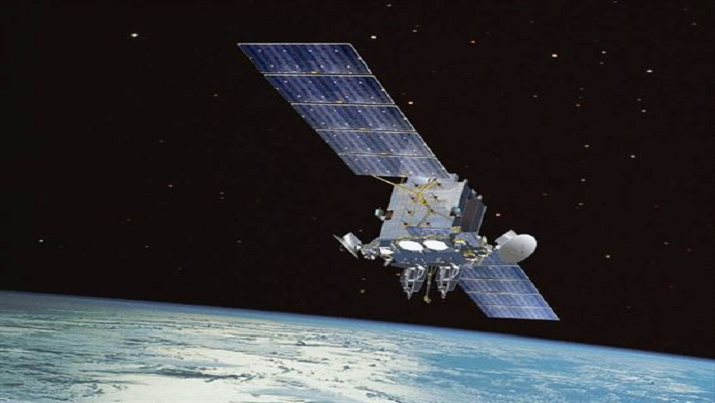 A satellite that would use quantum communications (U.S. Air Force)Lead author Christopher Pugh said: "Quantum key distribution (QKD) establishes cryptographic keys between two distant parties in a way that is cryptanalytically unbreakable. Ground-based QKD systems use optical fiber links and are limited to distances of a few hundred kilometers due to absorption losses, which get exponentially worse as the distance increases. Free space links have been shown to work over the ground with varying distances, both in stationary and moving tests. But despite losses due to geometric effects scaling quadratically with distance, the addition of atmospheric absorption and turbulence and the need to have a clear line of sight mean terrestrial free-space transmissions are also limited to a few hundred kilometers. Satellite-based system expands quantum communication to a global scale."
The team tested their system using the Twin Otter aircraft from the National Research Council. They carried out 14 passes over their ground transmitting system. They did this at varying distances, which achieved a quantum signal link for seven passes. It also had a secret key extraction for six of the seven successful passes.
Principle Investigator Professor Thomas Jennewein said: "This is an extremely important step which took almost eight years of preparation. It finally demonstrates our technology is viable. We achieved optical links at similar angular rates to those of low-Earth-orbit satellites, and for some passes of the aircraft over the ground station, links were established within 10 seconds of position data transmission. We saw link times of a few minutes and received quantum bit error rates typically between three and five percent, generating secure keys up to 868 kb in length.”
This breakthrough proves that the concept of quantum communication via satellites is feasible. The study was published in Quantum Science and Technology and can be found here.